Demonstration kit Electrotatics
Demonstrating Electrostatic Charge, Forces and Discharges
Use: Demonstration experiments on electrostatics, electric charge, forces between charged objects and electrostatic discharges in physics lessons
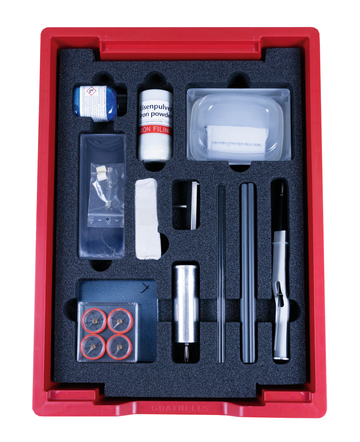
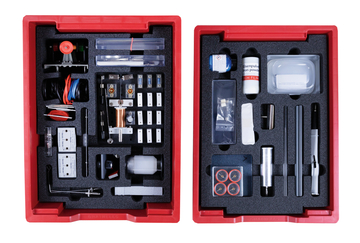
The Demonstration kit Electrotatics enables nine different, partly historical experiments on electrostatics to be demonstrated clearly in the classroom. The individual components are equipped with 4 mm plug pins and can be quickly exchanged and mounted on the insulated stand.
The experiments demonstrate a variety of electrostatic phenomena, including forces between charged objects, the tuft electroscope, electric dance, electric chimes, point discharge, electrostatic filtering and spark discharges on a lightning plate. Two experimental setups also demonstrate electrostatic ball movement.
Experiment leads with 4 mm plugs or the supplied connecting chains can be used to connect the setup to a charge source. For suitable experiments, the High Power Wimshurst Machine can be used as a high-voltage source. Experiment 8 requires a High Power Van De Graff Generator. Instructions are included.




In this experiment, the students investigate the force effect between two charged bodies.
In this experiment, a tissue paper screen is charged on the rod.
In this experiment, a tip wheel is placed on a needle and connected to a charge source using a connecting chain.
In this experiment, a chime is connected to a connecting chain at the charge source.
In this experiment, a ball is repelled from the electrode of the same name and attracted to the electrode of the opposite polarity with the aid of the influence machine by means of absorbed and stored charge quantities.
In this experiment, a ball electrode is used to make pieces of elderberry pulp dance in plastic cups.
In this experiment, a tip electrode in the plastic cup is filled with smoke and connected to the charge source with a connecting chain.
In this experiment, a ball is repelled from the electrode of the same name and attracted to the electrode of the opposite polarity with the aid of a high-voltage source through absorbed and stored charge quantities.
In this experiment, a lightning panel is connected to a charge source using connecting chains.
- 1 ×
- 1 ×
- 1 × Sphere, 30 mm dia., with plug
- 1 × Plastic box 140/50/35 mm
- 1 × Insulating rod
- 1 × Profile rail, 180 mm
- 1 × Support bail with plug
- 1 × Electrostatic ball-run
- 1 × Carillon
- 1 × Electric whirl
- 1 × Tissue paper umbrella
- 1 × Needle support with plug
- 1 × Lightning board
- 1 × Storage stand
- 1 × Foam insert grey, 430x320x10 mm
- 1 × Friction rod with bore
- 1 × Case w.point electrode
- 1 × Case w. sphere electrode
- 1 × Base plate 90 mm Ø with plug
- 1 × Set of 10 pcs. of pith in small box
- 1 × Pair of metal chains
- 1 × Foam insert for 50332, 425x310x80 mm
- 2 ×
- 1 ×
| Art-No. | items |
items
Add to Cart |
|---|---|---|
|
50315
|
High Power Wimshurst Machine | |
|
50300
|
High Power Van De Graff Generator |