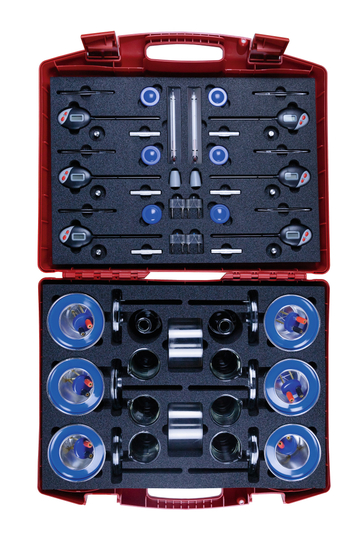
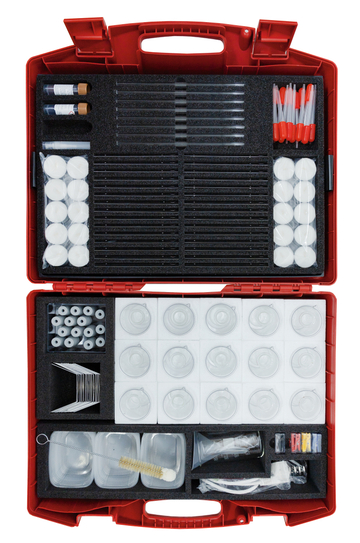
Students kit Heat
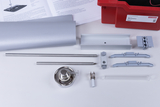
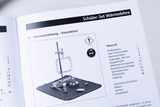
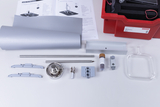
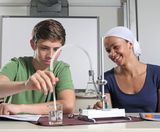
With the Student Set Heat, you can make key topics related to heat, temperature and thermal processes tangible through hands-on experiments in physics lessons. The set is designed for grades 8 to 10 and provides materials for one working group of 2 to 3 students.
Through a variety of experiments, students investigate temperature and the particle model, thermal expansion, heat transfer, states of matter and changes of state, as well as internal energy and heat capacity. This allows them to independently explore fundamental principles of thermal physics and understand them through their own observations.
A heat source in the form of a spirit burner is already included in the set, allowing the corresponding experiments to be carried out directly.


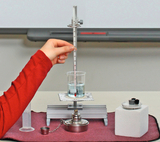
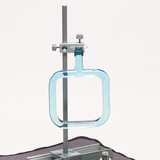


This experiment explains how a thermometer works. In addition, statements are made about how the supply of heat is related to a resulting change in temperature.
This experiment explains how a thermometer works. In addition, statements are made about how the supply of heat is related to a resulting change in temperature.
This experiment investigates the behavior of liquids in the heating and cooling process. In addition, it is investigated why the liquid behaves in this way.
This experiment shows the properties of a solid, after its heating.
This experiment shows the properties of a solid according to its heating.
This experiment investigates the thermal conductivity of different materials.
In this experiment, the thermal conductivity of water is determined.
The experiment examines the behavior of a bimetallic strip when it is heated and then cooled.
The experimental setup illustrates the radiation of heat and the associated transfer of heat through the air.
In this experiment, conclusions are drawn as to which properties of a substance are necessary so that thermal radiation can be absorbed.
We will shortly provide you with a description of the experiment at this point.
We will shortly provide you with a description of the experiment at this point.
We will shortly provide you with a description of the experiment at this point.
We will shortly provide you with a description of the experiment at this point.
We will shortly provide you with a description of the experiment at this point.
We will shortly provide you with a description of the experiment at this point.
In this experiment, the heating and cooling process of water is observed.
The experiment explains the principle of the reflection of thermal radiation and its effect on the temperature.
We will shortly provide you with a description of the experiment at this point.
- 2 × Bimetallic strip
- 1 × Student´s Calorimeter
- 1 ×
- 1 ×
- 1 × Paddle wheel
- 1 × Glass tube, bent right angled, 50 mm legs
- 1 ×
- 1 × Profile rail, 180 mm
- 1 × Glass tubing, straight, 100 mm with jet
- 1 × Metal axle, 125 mm
- 1 × Convection in liquids tube student type
- 1 × Set of (4) heat conducting rods, u-shaped
- 1 × Glass tubing, straight, 50 mm
- 1 × Thermometer -10 to +110 °C
- 1 × Metal body, aluminium
- 1 ×
- 1 × Rubber stopper 34/28 mm, 1 hole 8 mm
- 1 ×
- 1 × Rubber stopper 24/19 mm, 1 hole 8 mm
- 1 ×
- 1 ×
- 1 × Spirit burner, metal
- 1 × Heat protection gauze
- 1 × Lid
- 2 ×
- 2 × Tubular clips, 5 mm
- 1 × Storing Tray deep, red
- 1 × Plastic box 140/50/35 mm
- 1 × Dye (food colouring), red
- 1 × Test tube, 100 mm, plastic
- 1 ×
- 2 × Double clamp with slot, aluminium
- 1 × Glass tubing, straight, 200 mm
- 1 × Silicone tubing, 7/1,5 mm
- 1 × Measuring cylinder, PP, 25 ml
- 1 × Heat-resistant pad
- 2 × Rubber stopper with 6 mm bore
- 1 × Beaker, DURAN, NF, 100 ml
- 1 × Foam insert for 48500, 385x279x90 mm
- 2 ×
- 1 ×
- 1 ×
- 2 ×
- 5 ×
- 1 × Carton for SEG (large tray)