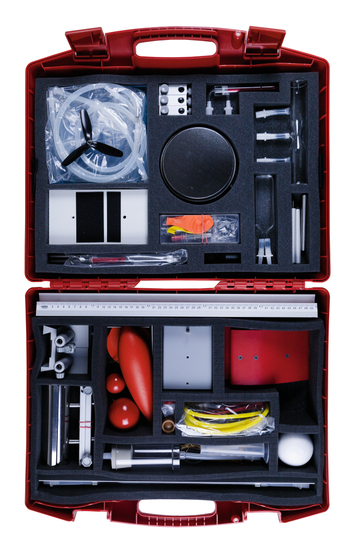
Demonstration kit Mechanics for the steel board
Demonstrating Mechanical Principles on Vertical Surfaces
Use: Demonstration experiments in physics lessons, alternatively for students presenting individual experiments
The Demo Set Mechanics provides a comprehensive range of experimental materials for demonstrating fundamental principles of solid-body mechanics. Topics range from weight force and the laws of levers to fixed and movable pulleys and pulley systems. Additional materials are provided for experiments on forces involved in elastic and plastic deformation.
The magnetic components allow clearly arranged experimental setups on vertical surfaces, making them particularly suitable for classroom demonstrations. Force meters with circular scales for 2 N and 5 N are provided for force measurements. A 150 mm coil spring with a maximum load of 10 N, as well as pulleys in various sizes, including 58 mm and 100 mm diameters, enable a variety of mechanical experimental setups.
A comprehensive guide with experiment descriptions and editable worksheets supports the preparation and implementation of the experiments.




Technical specifications
We will shortly provide you with a description of the experiment at this point.
We will shortly provide you with a description of the experiment at this point.
We will shortly provide you with a description of the experiment at this point.
We will shortly provide you with a description of the experiment at this point.
Students pull a loaded carriage up inclined planes of different heights and measure pulling force and distance. A shallower plane needs less force but a longer path, while ideal work remains comparable. They vary slope systematically, compare force-distance products, and apply the principle to ramps and screws.
Students zero an unloaded beam scale and balance an unknown body with calibrated masses. With equal lever arms, equilibrium indicates equal masses in the two pans. They use direct comparison as a measurement principle and explain why zeroing and horizontal alignment matter.
We will shortly provide you with a description of the experiment at this point.
We will shortly provide you with a description of the experiment at this point.
We will shortly provide you with a description of the experiment at this point.
Students balance a first-class lever using different load and effort arms and record the force values. At equilibrium, the products of force and arm length are equal on both sides. They organize paired values, test the torque model, and predict additional equilibrium arrangements.
Students move a load along the same side of the pivot and measure the effort at the end of the lever. The required force rises with load-arm length; both arms lie on the same side of the pivot. They compare lever classes and apply the lever law to a nutcracker, wheelbarrow, and forearm.
We will shortly provide you with a description of the experiment at this point.
Students pass a cord over a fixed pulley, vary the pulling direction, and measure force. The pulley reverses force direction while leaving its magnitude nearly unchanged. They compare vector direction and magnitude separately and explain the benefit of lifting from a convenient position.
Students suspend a load from a moveable pulley and measure tension in the two supporting cord sections. Each section carries about half the weight, while the pulling distance doubles. They construct force and distance balances and explain mechanical advantage without claiming an energy gain.
We will shortly provide you with a description of the experiment at this point.
- 1 × Scale on board
- 4 × Slotted mass, 50 g
- 4 × Slotted mass, 10 g
- 4 × Slotted mass, 10 g
- 6 × Slotted mass, 50 g
- 1 × Dynamometer, dial type 5N
- 1 × Pulley, unmounted, 58 mm dia.
- 2 ×
- 1 × Demonstration cord 5 m, 3 mm Ø
- 2 × Weight holder, 10 g
- 4 × Pulley, unmounted, 100 mm dia.
- 1 ×
- 2 × Metal axle, 80 mm
- 1 × Metal axle, 110 mm
- 2 × Scale plan, yellow, with bows
- 1 × Helical spring, 150 mm, 10 N
- 1 ×
- 2 × Clamp socket, 10 mm
- 1 × Momentum disc
- 5 × Tubular clips, 5 mm
- 1 ×
- 2 × Axis with clamping bushes on rod
- 1 × Dynamometer, dial type 2N
- 1 × Lever with bearing and pointer
- 1 × Storing diagram,int.vers.(Mechanics f.t.steelboard
- 2 × Support frame with two hooks
- 1 × Inclined plane without spareparts, magnetic adh.
- 1 × Foam insert for 43085, 515x350x100 mm
- 1 × Foam insert grey, knobbed515x360x30 mm
- 1 × Pulley hook
- 1 × Water level, 230 mm
- 4 × Spacer sleeve, 15 mm