Demonstration kit Flight and flying
Physical principles of lift, airflow and thrust
Use: Demonstration experiments and student experiments in physics lessons
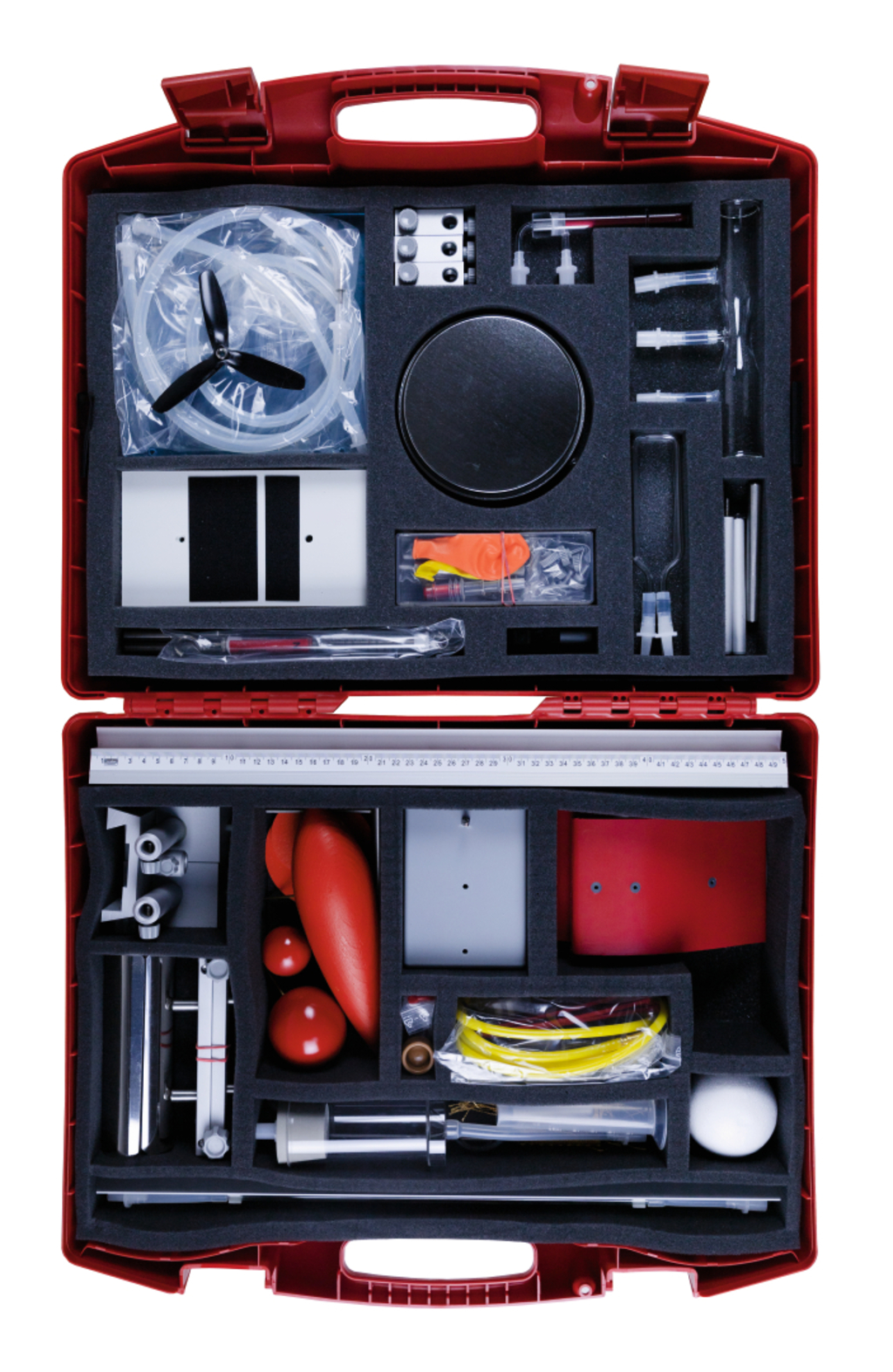
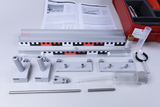
The Demonstration kit Flight and flying illustrates the physical principles of flight through 25 experiments. The focus is on static and dynamic lift as well as the principle of thrust. The materials can be used both for demonstrations by the teacher and for experiments conducted by students.
A hot-air balloon can be used to demonstrate static lift based on the difference in density between warm and cold air. Various wing models demonstrate the behavior of differently shaped bodies in airflow as well as the resulting pressure and drag conditions. A rocket model illustrates the principle of thrust based on the conservation of momentum.
Detailed instructions for all 25 experiments provide additional information and guidance on setup and implementation in the classroom.
An Air stream generator is not included in the set and is additionally required for the corresponding experiments. The airflow velocity generated by the device used should be at least 14 m/s.
The Air stream generator, 220 V (item no. 29010) is available as a suitable accessory and is listed on the product page as additionally required equipment.
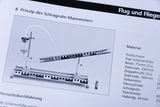


Students connect a Venturi tube to an inclined tube manometer and record pressure differences at one-third, one-half, and full airflow. They compare readings at points A and B and relate them to Bernoulli’s equation. This develops their ability to analyze a data series quantitatively and determine flow velocity from an indirectly measured quantity.
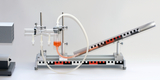
Students fill a foil balloon with warm air above a heat source and release it once sufficient lift develops. They explain the ascent by relating the lower density of heated air to lift and weight. They develop modeling skills by using the force balance to account for the observed motion.
Students fill and seal a black solar balloon and place it in direct sunlight in calm weather. They attribute its ascent to absorption of thermal radiation and warming of the enclosed air. Applying the effect of radiation to a practical device develops their ability to transfer physical knowledge to technical contexts.
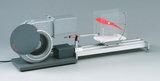
Students angle an air foil on a carriage and gradually increase the crosswise air stream. From the forward motion, they identify an aerodynamic reaction force perpendicular to the flow. They practice explaining an observation with a force model and describing the force direction precisely.
Students suspend a Styrofoam ball in vertical and then inclined airflow and bring a curved air foil close to it. They investigate how weight, dynamic pressure, and lift determine the ball’s stable position. Assigning several forces to the observed motion strengthens their ability to model a complex phenomenon with a force diagram.
Students stabilize a ball above the blower and lower a narrow tube toward it from above. The ball being propelled out makes the higher flow velocity and stronger force inside the tube visible. They develop the ability to infer a change in an invisible flow from a qualitative observation.
Students connect three U-tube manometers to different points on a Venturi tube and observe the liquid levels at maximum airflow. In the constriction, they compare increased flow velocity with reduced static pressure. Interpreting three readings in parallel develops their ability to map data to locations and explain it with a flow model.
Students assemble an inclined tube manometer, fill it with colored water, and produce small pressure changes through a hose. They compare displacement in the inclined liquid column with the U-tube principle. They assess two measurement methods and explain why the inclined arrangement displays small pressure differences more sensitively.
Students connect the tip and side measurement chamber of a Pitot tube to an inclined tube manometer in several configurations. From the readings, they distinguish total, static, and impact pressure. Systematically varying the connections strengthens their ability to explain the functions of components in a measurement method.
Students shape a paper strip to an airfoil and observe it being pressed below and lifted above in airflow. They vary or compare the conditions specified in the handout and relate the observed effect to the underlying flow or force relationship. This specifically develops their ability to analyze evidence, use physical models, and justify conclusions for this setup.
Students use a probe at three points on each airfoil surface to measure pressure distribution at −15°, 0°, and +15° setting angles. They vary or compare the conditions specified in the handout and relate the observed effect to the underlying flow or force relationship. This specifically develops their ability to analyze evidence, use physical models, and justify conclusions for this setup.
Students weigh a lifting power model at numerous setting angles and two air speeds and calculate lift from the weight differences. They vary or compare the conditions specified in the handout and relate the observed effect to the underlying flow or force relationship. This specifically develops their ability to analyze evidence, use physical models, and justify conclusions for this setup.
Students hold a thread comb above an airfoil at several setting angles and document the transition from laminar flow to turbulence. They vary or compare the conditions specified in the handout and relate the observed effect to the underlying flow or force relationship. This specifically develops their ability to analyze evidence, use physical models, and justify conclusions for this setup.
Students place a plate, ball, and streamlined object of equal diameter on a carriage and compare its motion under identical airflow. They vary or compare the conditions specified in the handout and relate the observed effect to the underlying flow or force relationship. This specifically develops their ability to analyze evidence, use physical models, and justify conclusions for this setup.
Students use a horizontally zeroed dynamometer to measure the air-stream resistance of a plate, ball, and streamlined object. They vary or compare the conditions specified in the handout and relate the observed effect to the underlying flow or force relationship. This specifically develops their ability to analyze evidence, use physical models, and justify conclusions for this setup.
Students record airfoil drag at numerous positive and negative setting angles and at two air speeds. They vary or compare the conditions specified in the handout and relate the observed effect to the underlying flow or force relationship. This specifically develops their ability to analyze evidence, use physical models, and justify conclusions for this setup.
Students move a thread comb in front of, above, and behind a plate, ball, and streamlined object and sketch the patterns. They vary or compare the conditions specified in the handout and relate the observed effect to the underlying flow or force relationship. This specifically develops their ability to analyze evidence, use physical models, and justify conclusions for this setup.
Students move a freely rotating airscrew toward a plate step by step and observe its direction of rotation reverse. They vary or compare the conditions specified in the handout and relate the observed effect to the underlying flow or force relationship. This specifically develops their ability to analyze evidence, use physical models, and justify conclusions for this setup.
Students allow an airscrew to rotate and slide in airflow and then interrupt the stream abruptly. They vary or compare the conditions specified in the handout and relate the observed effect to the underlying flow or force relationship. This specifically develops their ability to analyze evidence, use physical models, and justify conclusions for this setup.
Students mount a freely rotating airscrew on a carriage and measure its propulsive force as air speed increases. They vary or compare the conditions specified in the handout and relate the observed effect to the underlying flow or force relationship. This specifically develops their ability to analyze evidence, use physical models, and justify conclusions for this setup.
Students position an inclined airscrew in airflow and observe its rotation and upward motion along the shaft. They vary or compare the conditions specified in the handout and relate the observed effect to the underlying flow or force relationship. This specifically develops their ability to analyze evidence, use physical models, and justify conclusions for this setup.
Students accelerate an airscrew horizontally in airflow and then swivel its shaft rapidly upward. They vary or compare the conditions specified in the handout and relate the observed effect to the underlying flow or force relationship. This specifically develops their ability to analyze evidence, use physical models, and justify conclusions for this setup.
Students attach an inflated balloon with a valve to a carriage and observe its motion as the air escapes in a controlled way. They vary or compare the conditions specified in the handout and relate the observed effect to the underlying flow or force relationship. This specifically develops their ability to analyze evidence, use physical models, and justify conclusions for this setup.
Students mount an air foil so it can move at a fixed setting angle and alternately interrupt the upper and lower airflow. From the different responses, they determine the contributions of negative pressure above and excess pressure below. The controlled comparison develops their ability to isolate variables and test a hypothesis about lift experimentally.
- 1 ×
- 1 × Rocket model ROKIT
- 1 ×
- 1 × Tire pump
- 1 × Balance with solar cell
- 1 ×
- 1 × Support rod
- 2 × Rider with clamping tube 75 mm
- 1 × Prandtl tube
- 3 × Double clamp with slot, aluminium
- 1 × U-tube manometer
- 1 × Lifting power model
- 1 × Stand rod, 100 mm
- 2 × Stand rod, 250x10 mm dia. stainless steel
- 1 × Solar balloon
- 1 ×
- 1 × All purpose rail, 50 cm
- 1 × Dry combustibles ESBIT 20 tablets
- 1 × Hot air balloon model
- 1 × Venturi tube
- 1 ×
- 1 ×
- 1 ×
- 1 × Rider with clamping tube 30 mm
- 1 × Burner
- 1 ×
- 1 × Measuring cylinder, PP, 25 ml
- 1 × Heat stack, 150 mm, for Esbit and metal plate
- 1 × Balloons with reinforced surface tension
- 1 × Dye (food colouring), red
- 1 × Holding clip on rod, 15 mm
- 1 ×
- 1 ×
- 1 × Dynamometer, 200 mN
- 1 × Adjustable feet for rails
- 1 × Styrofoam ball, 70 mm Ø
- 1 × Silicone oil, 10ml
- 1 × Storing diagram,int.vers.(Flight and Flying)
- 1 × Foam insert 1 for 29008, 495x350x25 mm
- 1 × Metal plate, 150 mmØ
- 1 × Foam insert 2 for 29008, 510x370x80 mm
- 1 × Lidfoam grey,515x355x10mm
- 1 ×
- 1 ×
- 1 ×
| Art-No. | items |
items
Add to Cart |
|---|---|---|
|
29010
|
Air stream generator |