Students kit Floating and sinking
Investigating Floating, Sinking and Water Displacement
Grade level: Grades 2–3
Number of students: 16–28 students
Materials: for up to 12 working groups
Use: Student experiments on floating and sinking, material properties, shape, water displacement, buoyancy, load capacity and surface tension
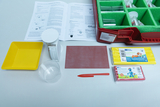
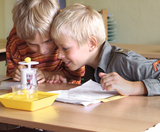
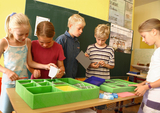
With the Students kit Floating and sinking, students investigate fundamental principles that determine how objects behave in water. At different experiment stations, they observe, compare and test various factors and gradually develop an understanding of why objects float or sink.
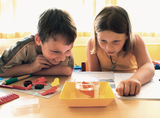
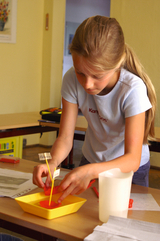
A central part of the activities involves making boats from two different types of modelling clay. One type is less dense than water and floats, while the heavier modelling clay initially sinks. However, when the heavier clay is shaped into a suitable hollow form, it can also float. This allows students to experience directly that not only the material but also the shape of an object influences whether it floats or sinks.
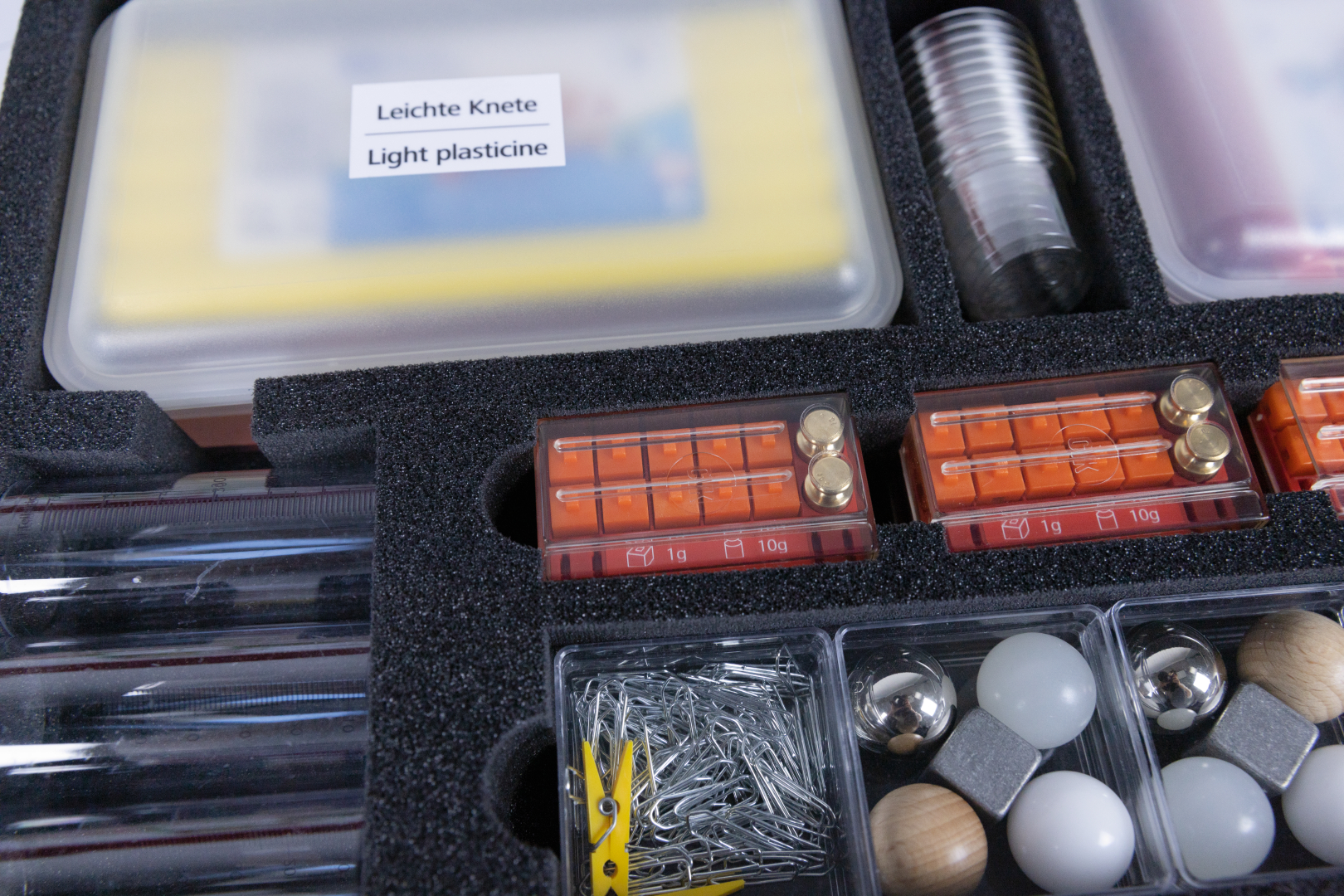
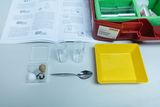
Spheres and cubes made from wood, steel, aluminium and different plastics provide further opportunities for investigation. Students compare mass, material and volume and observe how objects displace water when immersed. Using balances, they can also investigate how the apparent weight of an object changes in water.
Further stations focus on the loading and carrying capacity of boats, possible reasons why boats sink and the surface tension of water. In addition to learning fundamental physical principles, students practise scientific skills such as careful observation, comparison and conducting experiments under consistent conditions.
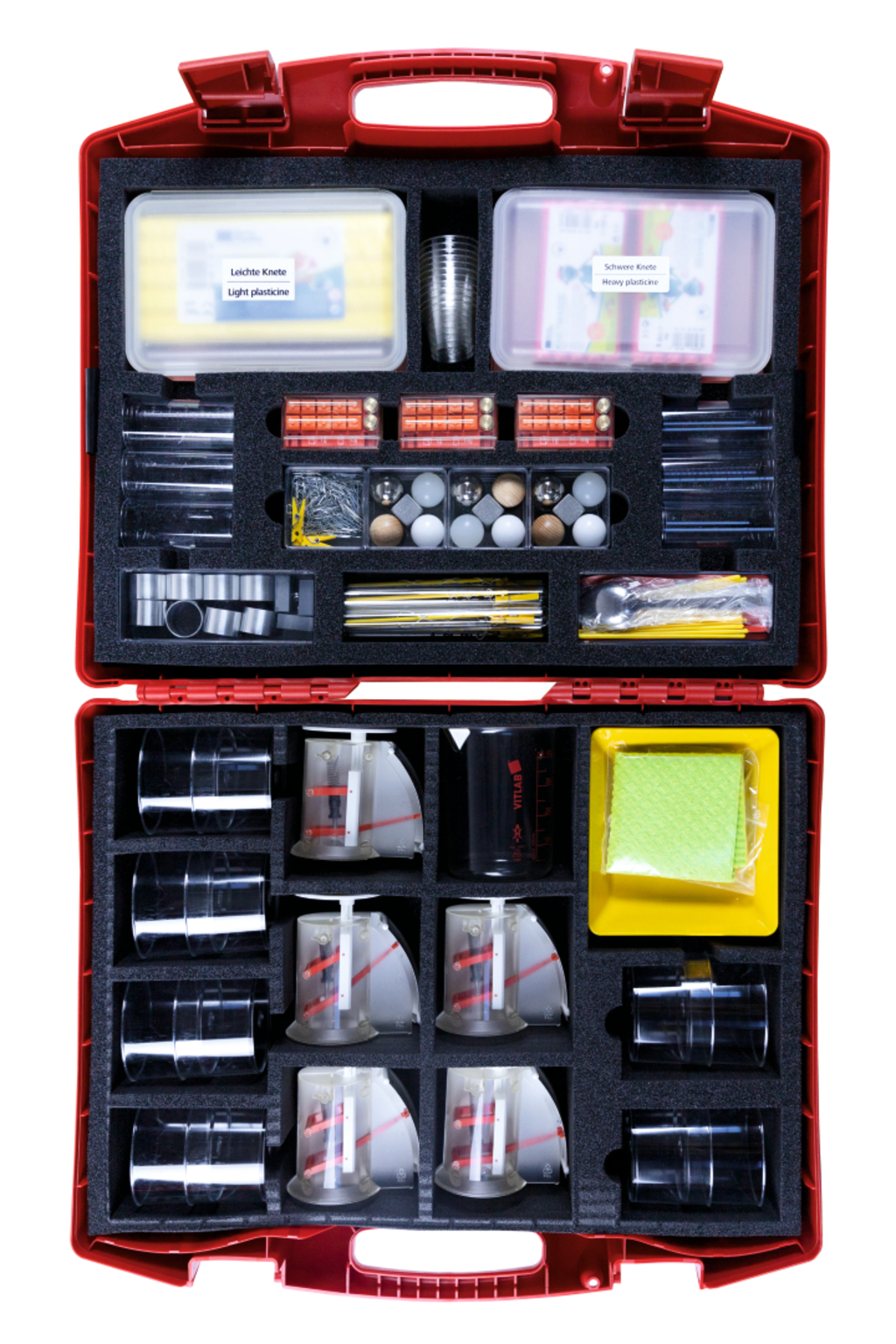


Technical specifications
Size of kit: 540 x 450 x 150 mm
The main goal of this tutorial is the ability to divide the dough into equal portions in the box.
The children fill mini cups with water and modeling clay of different weights. You watch what happens to the putty.
The children form balls of different sizes from the two types of play dough and drop them into the water after they have determined the mass with the scales.
The learning outcome from working on station 3 lies in the realization that hardly any ship floats anymore because the material from which it was built also does. In addition, the children learn to name the materials and can – in a simple context – give examples of ships and boats.
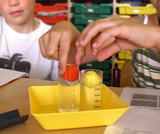
Here the children find out that all balls of the same size displace the same amount of water, regardless of their mass!
The children can easily see the reason why the amounts of clay must be the same, even if they reason with terms like "fair". Here, in conversations, there is a good opportunity to propaedeutically discuss the conditions under which scientific experiments become meaningful.
The children realize that the ship is already displacing water when you put it in the water and even more when you load it.
The children like to deal with sinking and find at least the possibilities mentioned in the "solution hiding place". Some of the terms mentioned there are new to many students (leak, capsize, fill with water).
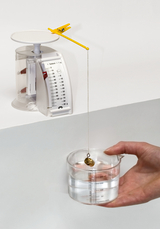
If we hang the two weights in the water on the "fishing rod" - what will happen? Will there be a difference?
We will shortly provide you with a description of the experiment at this point.
This beetle's "trick" is to use the surface tension of water. As the children find out in their experiments with thin discs of different sizes made of "heavy" modeling clay, we also succeed in this "trick".
We will shortly provide you with a description of the experiment at this point.
We will shortly provide you with a description of the experiment at this point.
We will shortly provide you with a description of the experiment at this point.
The children form a portion of modeling clay – which is a low cylinder at the beginning – first into a cube, then into a/one... and keep putting it into the water - no body floats. Only the hollow, bowl-shaped body floats.
We will shortly provide you with a description of the experiment at this point.
- 1 ×
- 1 × Packet of heavy modelling clay, red
- 2 × Plastic box 140/50/35 mm
- 1 ×
- 3 × Ball, nickel-plated steel
- 3 ×
- 5 × Dial balance, 100 g
- 12 × Water dish
- 6 ×
- 12 × Plastic beaker, 250 ml, with scale
- 1 ×
- 3 × Plastic ball, POM, 25 mm Ø
- 3 × Wooden ball, 25 mm Ø
- 1 ×
- 3 × Teaspoon
- 3 × Plastic ball, PP, 25 mm Ø
- 1 × Overflow beaker
- 12 × Mat
- 8 × Pastry cutter, aluminium,25 mm
- 12 × Plastic knife
- 1 × Cleaning cloth
- 6 × Graduated cylinder, 60 ml
- 1 × Storing diagram,int.vers.
- 1 × Foam insert 1 for 31900, 505x355x45 mm
- 3 × Aluminium cube 18x18x18mm
- 1 × Foam insert 2 for 31900, 515x370x95 mm
- 4 × Plastic box 60x60x30 mm
- 5 × Fishing rod with string and hook
- 11 × Beaker, plastic 30 ml
- 2 ×
- 12 ×