Mini-Kit ‘Air and water’
Investigating the Properties, Pressure and Flow of Air and Water
Age: 8–14 years
Materials: for 1 working group or demonstration
Use: Student experiments on the properties of air and water, pressure, buoyancy, flow energy and fundamental technical applications
With the Mini-Kit ‘Air and water’, students investigate fundamental physical properties of air and water through practical experiments. The set is suitable for one working group and can also be used for classroom demonstrations.
Students begin by investigating the properties of water and observe, for example, how water displaces air, how pressure is transmitted through liquids and how communicating vessels work. Further experiments explore capillary forces, buoyancy and the force of flowing water.
In the topic area air, students investigate the compression and expansion of gases, air pressure and negative pressure, as well as the force produced by moving air. A U-tube can also be used to demonstrate fundamental principles of pressure measurement.
Technical applications transfer the observed phenomena to practical operating principles. These include a hydraulic lift, pipette, U-tube manometer, recoil principle and air cushion principle. In this way, fundamental properties of air and water can be directly connected with technical applications.
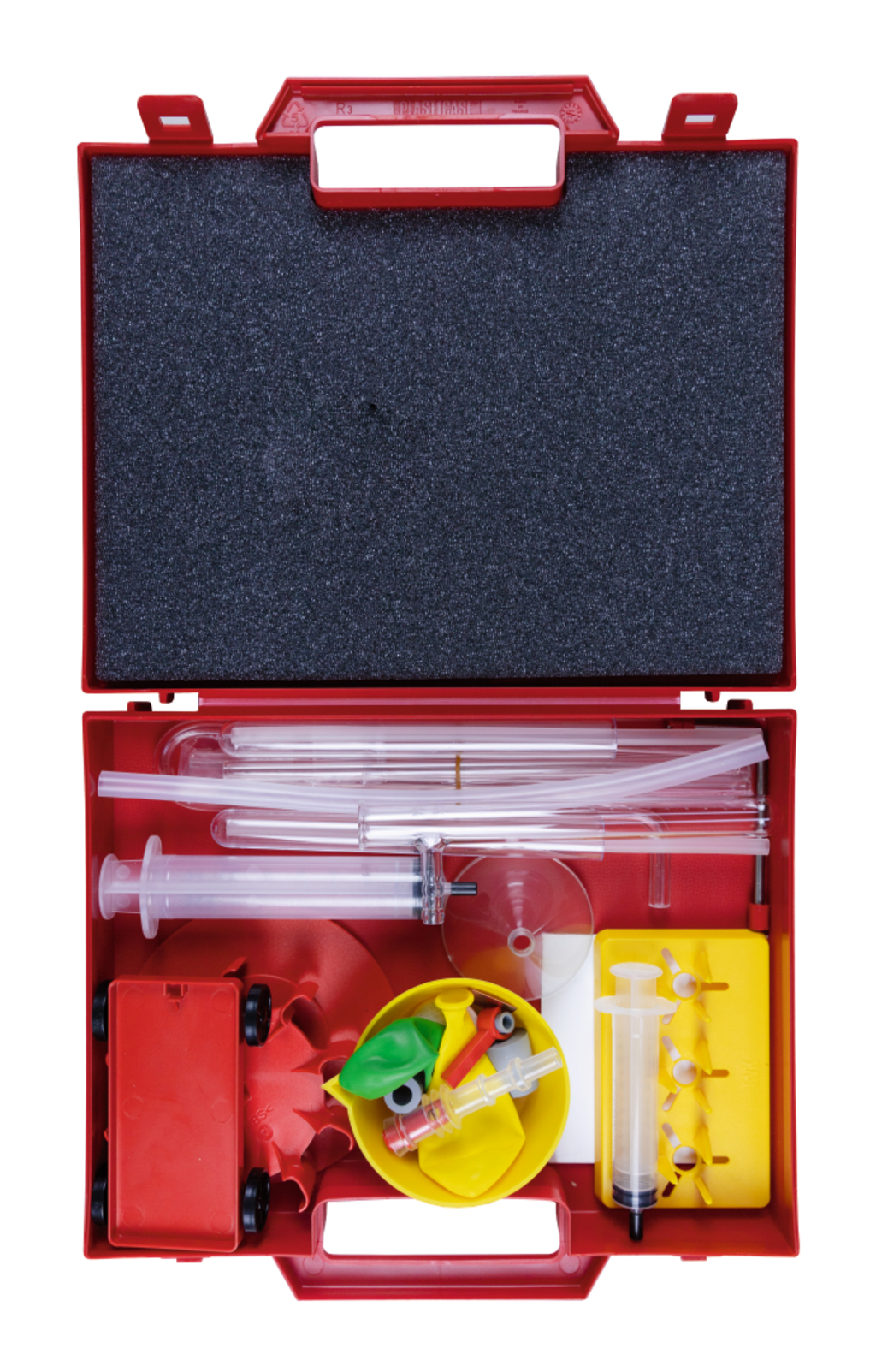
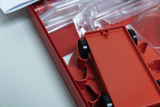
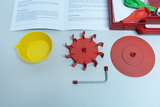
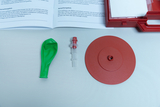
The equipment includes a paddle wheel, glass tubes, syringes, U-tube, air cushion plate, recoil cart, floating body and various tubes. Instructions support students in carrying out the experiments.



Technical specifications
Size: 270 x 210 x 50 mm
Investigate whether water is a body.
Try to force air out of an open container with water.
The surface of the water is to be examined.
Surface of the water is examined.
Capillary forces are examined.
Propagation of the pressure effect in liquids is investigated.
Investigation of the functioning of a hydraulic jack.
Investigating how a pipette works.
Investigate buoyancy in water.
The force of flowing water is observed.
Displace water with air in an open container.
Investigate compression of the air and its effect.
Investigate how a U-tube pressure gauge works.
Observe water displacement by air.
Investigate the effect of the negative pressure.
Observation of how forces are transmitted through air.
Investigation of the energy of flowing air.
Try to displace air in a closed container with water.
Investigate if air is a body.
Expansion of the air under heating is investigated.
Pressure effect of water is examined.
Effect of air pressure is studied.
The phenomenon of a water column is observed.
Investigation of the recoil principle and the associated energies.
Energies at an air cushion are observed.
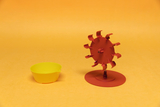
- 1 × Water basin, plastic, 80 mm dia.
- 1 × Carriage
- 1 × Paddle wheel
- 2 × Glass tubing, straight, 200 mm
- 1 × Rubber stopper 18/14 mm, 1 hole 8 mm
- 1 × Rubber stopper 18/14 mm
- 1 ×
- 1 × Clamp socket, 10 mm
- 2 × Tubular clips, 5 mm
- 1 ×
- 1 × Syringe with nozzle, 30 ml
- 1 × Balloons with reinforced surface tension
- 1 × Air-cushion disc
- 1 × Test tube with hose
- 2 ×
- 1 ×
- 1 × Floating platforms for compass needle
- 1 × Silicone tubing, 7/1,5 mm
- 1 × Lidfoam R3, grey 260x200x10 mm
- 1 × Screen plastic, white 90x90x2 mm
- 1 × Funnel 60 mm with short underrun for 16102
- 1 × U-shaped tube, perspex
- 2 ×
- 1 ×
- 1 ×
- 1 ×
- 1 ×
- 1 ×
- 1 ×