Experiment Kit Electric Circuits
Discover the Basics of Electricity Through Hands-On Learning
Grade level: Grades 3–4
Number of working groups: 15
Use: Student experiments on open and closed circuits, series and parallel circuits, conductive and non-conductive materials, as well as light, heat, motion and electrical safety
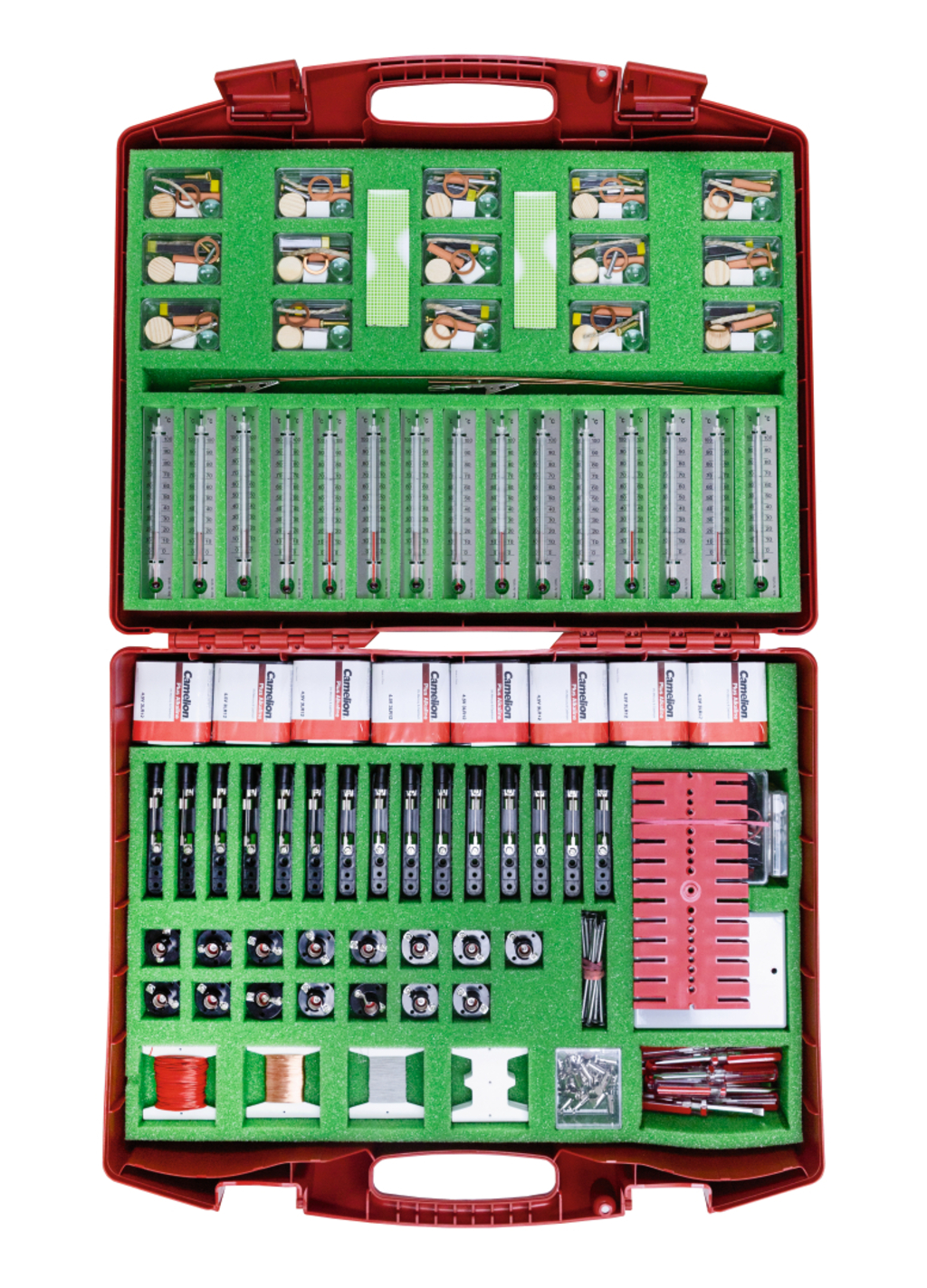
With the Experiment Kit Electric Circuits, students in Grades 3 and 4 investigate fundamental principles of electricity through hands-on experiments. The materials are designed for 15 working groups and provide a practical introduction to electric circuits and their everyday applications.
Students investigate the conditions required for a light bulb to illuminate and learn why electric current can only flow in a closed circuit. They explore safe electrical connections and distinguish between conductive and non-conductive materials. Building on these fundamentals, students construct and investigate series and parallel circuits.
Further activities demonstrate how electrical energy can be used to produce light, heat and motion. Students build lamp circuits and vehicle lighting systems, work with different types of switches and investigate a heating wire. They can also construct a simple electromagnet.
An important topic is the safe use of electricity. Students learn about potential electrical hazards and investigate materials that can provide protection against electric shock. Everyday applications such as bicycle lights, household lighting and switches provide practical connections to familiar situations.
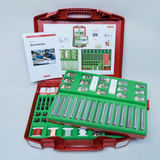
The teacher's guide includes 33 experiment stations with reproducible worksheets. Playful activities such as the Trembling Roller Coaster, Batt-Man and Robot Game encourage independent learning while combining scientific concepts with practical technical challenges.


Technical specifications
Size of kit: 540 x 450 x 150 mm
Children are encouraged to light up the lightbulb in different ways. This task has two solutions, once the long pole sheet (minus) touches the contact plate and the short pole sheet (plus) touches the thread and vice versa.
The children repeat the insights about handling batteries and light bulbs from station 2 and they learn to assess the condition of batteries.
With this text about Alessandro Volta, a recurring framework plan requirement is met, to acquaint the children with "researchers" and "inventors" or even namesakes.
The children usually bring the “old” batteries they need from home. On average, five dead batteries can be found there. Since the "residence time" of batteries in households is four years on average according to the statistics of the GRS battery take-back service, it is conceivable that copies that have already "expired" are brought along.
Children who deal with Station 11 in partner work develop an elementary school idea of what is happening in the battery. It will be deepened later in secondary school.
The aim of these two stations is to become aware of how many lamps can be found in our households and the different shapes they have.
The suggestion encourages the children to set up a simple electrical circuit and make it so stable that it works safely even with violent movements.
In terms of goals, this suggestion is similar to Station 15, but the technical problem lies less in the stability of the connections than in the narrowness of the pencil case. Even if you have partially cleared them out, the binding posts are not easy to attach in such a way that they fit in your pocket and do not cause a short circuit.
The children build a milk carton ship out of a milk carton, which they lower into the water (in a tub).
The "test" leads to a lasting examination of the children with the question of the technically correct, mechanically stable connection of the lamp.
The installation of lighting in vehicles (station 18) always awakens the desire to mount two lamps. This created a motivating situation to deal with series and parallel circuits.
With the double-sided station sheet 20, the children practice something very important, troubleshooting.
This suggestion complements the experimental setup of Station 16.
It is a worthwhile task to realize how many switches one encounters at home - Station 22 encourages this.
Here, what the children recognized from the lever switch in the box is transferred to three switch types that are common in the household: a “gap” in a circuit is always closed or opened.
Many outline plans suggest building your own switches. The children can make or apply elementary experiences. The station sheet encourages you to try out two different switch types, the rotary switch and the button.
The children study bicycle lighting technology.
The children get to know heating wires and test them out on a pole plate.
The aim of dealing with this text is to know the danger that comes from currents over 9 volts. In many cases, they are referred to in writing.
To answer this question experimentally, the substances contained in the collection of small items are tested. The station sheet shows which material is involved.
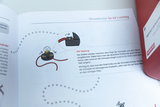
The "trembling roller coaster" is called that because of its shape and because you need a steady hand if you don't want to light up the lamp while you are guiding the loop along the track. The very making of this game leads to an exploration of the simple electric circuit. The point of using it is not to close the circuit.
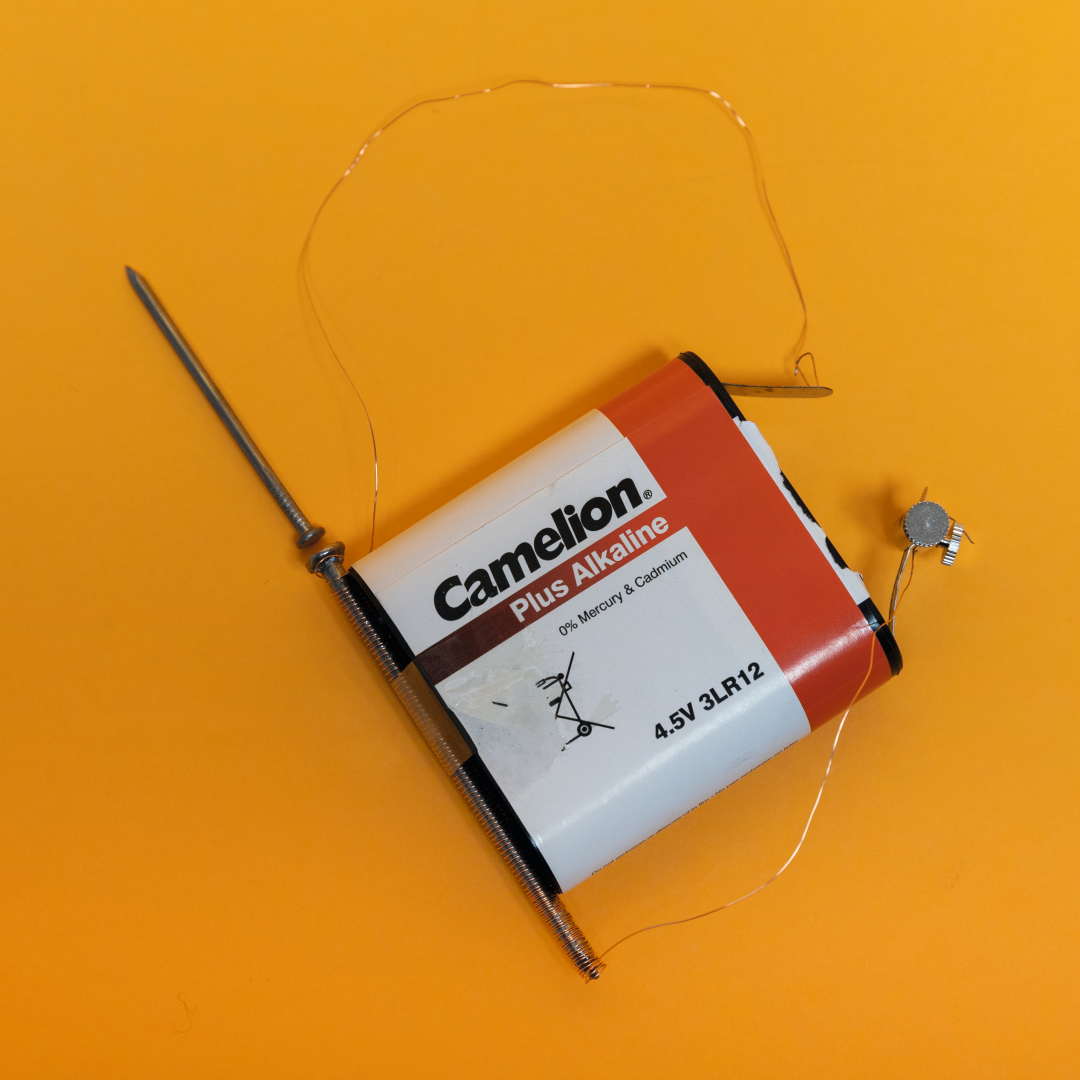
If you touch the pole plate with the free end of the wire, the wrapped nail becomes magnetic - it has become an electromagnet. From this you can make different games ... With it you can z. B. Carefully pick up another nail. If the current flow is interrupted, the magnetic force is released and the "load" falls off when it is heavy enough.
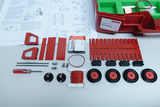
- 1 ×
- 1 ×
- 1 × Plastic base, grey, 120 x 90 mm with 2 terminals
- 15 ×
- 2 × Crocodile clip with 4 mm plug
- 1 ×
- 1 ×
- 1 × Wooden board, 120 x 90 mm
- 2 × Copper wire, supple, 1.5 mm dia., 430 mm long
- 1 × Copper wire, varnished, 0,25 mm Ø
- 1 × Copper wire, half-hard, 2 mm dia., 200 mm long
- 1 × Heating wire, covered, 0,20 mm Ø
- 1 ×
- 1 × Construction set for vehicle with fishertechnic components
- 7 × Spools, for keeping enamelled copper wire pieces after experiment
- 15 × Screw driver 110 mm
- 2 × Bulb 3,5 V / 0,2 A
- 1 × Copper wire with insulation
- 15 × Thermometer student type –5 to +100 °C
- 15 × Lamp holder with stand
- 32 × Terminal clips, 7 mm
- 15 × Knife switch, single pole, single throw
- 15 × Battery cell, 4,5 V 3R12
- 1 × Storing diagram,int.vers.