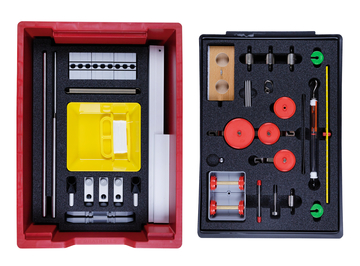
Students kit Mechanics
Explore mechanical principles in solids, liquids and gases
Grade level: 7–10
Number of students: 2–3 students
Use: Student experiments in one working group
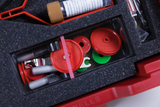
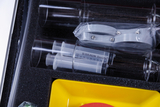
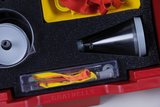
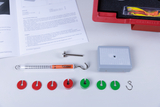
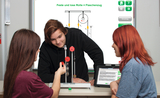
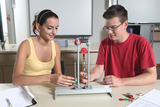
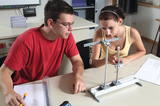
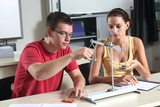
The Students Kit Mechanics 1 provides a comprehensive range of experimental materials covering fundamental laws of mechanics. The experiments address solids, liquids and gases and cover a variety of topics relevant to physics lessons.
Experiments with solids cover topics including forces and their effects, levers, pulleys and pulley systems, inertia, friction and inclined planes. Further experiments address pressure and buoyancy in liquids as well as air pressure and pressure relationships in gases.
The experimental setups cover fundamental physical laws and principles including Newton’s laws, Hooke’s law, Archimedes’ principle, Boyle’s law and Gay-Lussac’s law. Detailed experiment instructions with reproducible worksheets and a teacher’s guide with answers support the preparation, implementation and evaluation of the experiments.
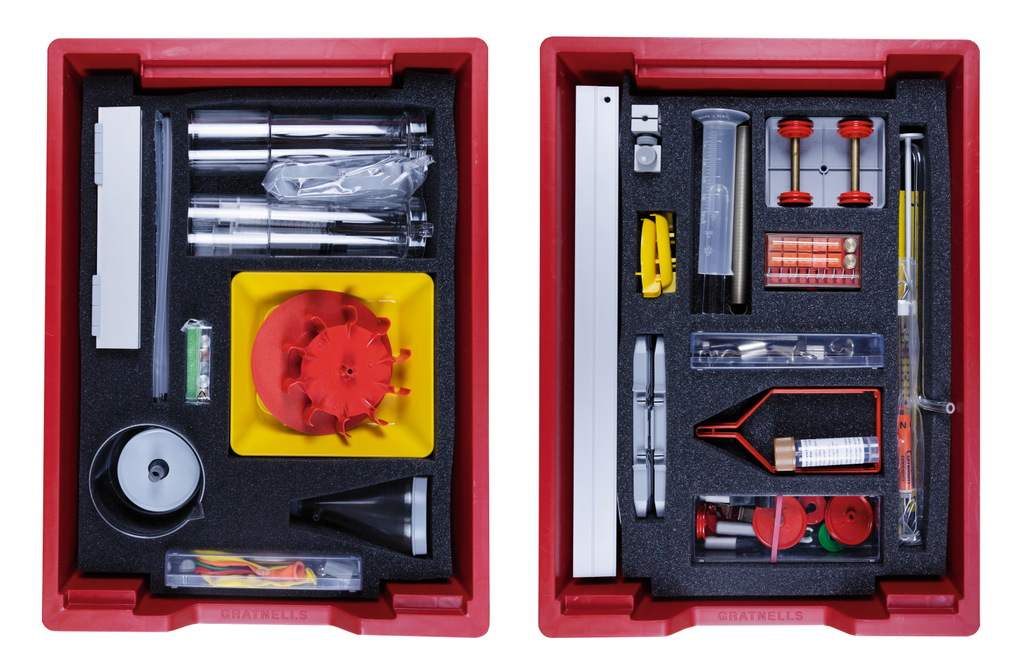


We will shortly provide you with a description of the experiment at this point.
We will shortly provide you with a description of the experiment at this point.
We will shortly provide you with a description of the experiment at this point.
We will shortly provide you with a description of the experiment at this point.
We will shortly provide you with a description of the experiment at this point.
We will shortly provide you with a description of the experiment at this point.
We will shortly provide you with a description of the experiment at this point.
We will shortly provide you with a description of the experiment at this point.
We will shortly provide you with a description of the experiment at this point.
We will shortly provide you with a description of the experiment at this point.
We will shortly provide you with a description of the experiment at this point.
We will shortly provide you with a description of the experiment at this point.
We will shortly provide you with a description of the experiment at this point.
We will shortly provide you with a description of the experiment at this point.
We will shortly provide you with a description of the experiment at this point.
We will shortly provide you with a description of the experiment at this point.
We will shortly provide you with a description of the experiment at this point.
We will shortly provide you with a description of the experiment at this point.
We will shortly provide you with a description of the experiment at this point.
We will shortly provide you with a description of the experiment at this point.
We will shortly provide you with a description of the experiment at this point.
We will shortly provide you with a description of the experiment at this point.
We will shortly provide you with a description of the experiment at this point.
We will shortly provide you with a description of the experiment at this point.
We will shortly provide you with a description of the experiment at this point.
We will shortly provide you with a description of the experiment at this point.
We will shortly provide you with a description of the experiment at this point.
We will shortly provide you with a description of the experiment at this point.
We will shortly provide you with a description of the experiment at this point.
We will shortly provide you with a description of the experiment at this point.
We will shortly provide you with a description of the experiment at this point.
We will shortly provide you with a description of the experiment at this point.
We will shortly provide you with a description of the experiment at this point.
We will shortly provide you with a description of the experiment at this point.
We will shortly provide you with a description of the experiment at this point.
We will shortly provide you with a description of the experiment at this point.
We will shortly provide you with a description of the experiment at this point.
We will shortly provide you with a description of the experiment at this point.
We will shortly provide you with a description of the experiment at this point.
We will shortly provide you with a description of the experiment at this point.
We will shortly provide you with a description of the experiment at this point.
We will shortly provide you with a description of the experiment at this point.
We will shortly provide you with a description of the experiment at this point.
We will shortly provide you with a description of the experiment at this point.
We will shortly provide you with a description of the experiment at this point.
We will shortly provide you with a description of the experiment at this point.
We will shortly provide you with a description of the experiment at this point.
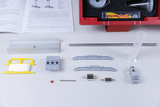
- 2 × Storing Tray shallow, red
- 1 × Leaf spring with bore
- 1 × Lid with bore for suction flask
- 2 ×
- 1 × Weight set for beam balance
- 1 × Weight holder, 10 g
- 1 × Rubber stopper 13/9 mm
- 1 × Rubber stopper 18/14 mm, 1 hole 8 mm
- 1 × Support clip, 8 mm Ø, on rod
- 2 × Holding clip on rod, 15 mm
- 1 ×
- 5 × Tubular clips, 5 mm
- 2 × Lid
- 2 ×
- 1 × Dynamometer, 1 N
- 1 × Plastic beaker, 250 ml, with scale
- 2 ×
- 1 × Plastic box 140/50/35 mm
- 1 × Water dish
- 1 × Coloring agent blue (food color)
- 1 × Pulley, unmounted, 43 mm dia. with hook
- 1 × Balloons with reinforced surface tension
- 1 × Air-cushion disc
- 1 × Carriage with friction foil, with weight and threaded rod
- 1 × Measuring cylinder, PP, 25 ml
- 2 × Metal axle, 50 mm
- 1 × Metal axle, 80 mm
- 1 ×
- 2 × Double clamp with slot, aluminium
- 1 × Profile rail, 180 mm
- 1 × Profile rail with drill hole, 360 mm
- 1 × Test tube, 100 mm, plastic
- 1 × Pulley, unmounted, 28 mm dia.
- 1 × Pulley, unmounted, 43 mm dia.
- 1 × Suction flask
- 1 × Paddle wheel
- 2 × Slotted mass, 10 g
- 3 × Slotted mass, 10 g
- 1 × Slotted mass, 50 g
- 1 × Slotted mass, 50 g
- 1 × Helical spring, 150 mm, 10 N
- 1 × Silicone tubing, 7/1,5 mm
- 1 × Tread on spool
- 2 ×
- 1 ×
- 1 ×
- 2 × Scale plan, yellow, with bows
- 1 × Carton for SEG (large tray)
- 1 × Set of 2 retaining rings
- 1 × Foam insert 1 for 43000, 415x310x65 mm
- 1 × Foam insert 2 for 43000, 380x270x50 mm
- 2 × SEG Lidfoam, grey 10 mm
- 1 × Rising tube, flexible
- 1 × U-shaped tube, perspex
- 2 ×
- 2 ×
- 1 ×
- 2 ×
- 4 ×
- 1 ×
- 1 ×
- 1 ×
- 2 ×
- 4 ×
- 1 ×
- 1 ×