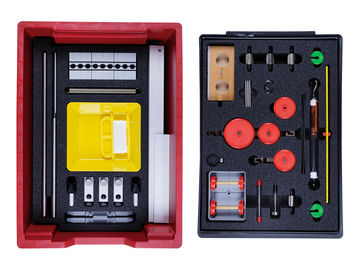
Students kit Mechanics
Explore mechanical principles in solids, liquids and gases
Grade level: 7–10
Number of students: 2–3 students
Use: Student experiments in one working group
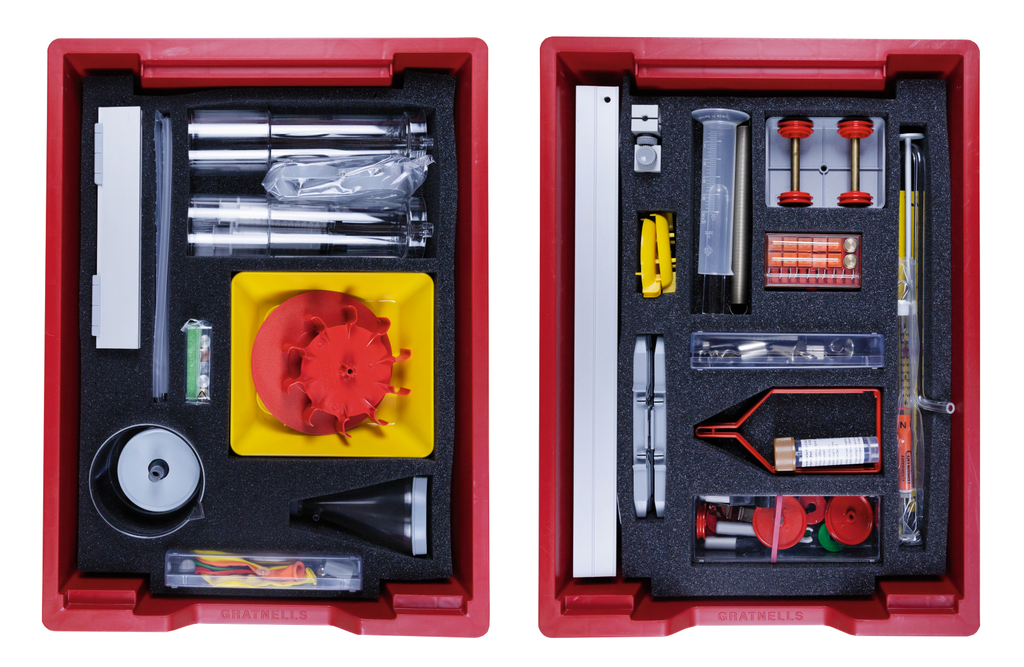
The Students Kit Mechanics 1 provides a comprehensive range of experimental materials covering fundamental laws of mechanics. The experiments address solids, liquids and gases and cover a variety of topics relevant to physics lessons.
Experiments with solids cover topics including forces and their effects, levers, pulleys and pulley systems, inertia, friction and inclined planes. Further experiments address pressure and buoyancy in liquids as well as air pressure and pressure relationships in gases.
The experimental setups cover fundamental physical laws and principles including Newton’s laws, Hooke’s law, Archimedes’ principle, Boyle’s law and Gay-Lussac’s law. Detailed experiment instructions with reproducible worksheets and a teacher’s guide with answers support the preparation, implementation and evaluation of the experiments.
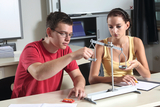


Students immerse 25 g and 50 g hook masses in a graduated cylinder initially filled to 15 ml and read the rise in water level. Comparison with geometrically calculated body volumes shows that displaced liquid volume equals the volume of the immersed body. They assess small deviations caused by the hooks and reading position and justify using displacement for irregular bodies.
Students determine the volume of five metal cylinders by water displacement and their mass from dynamometer readings. They calculate mass divided by volume for each pair of values and distinguish materials despite identical shapes. This combines two measurement methods, quantitative table analysis, and use of density as a material-specific model.
Students load a freely suspended helical spring in 25 g steps and measure its length and extension for each force. A graph of extension against force reveals the linear relationship within the elastic range. They create and interpret a data graph, determine the constant ratio F/Δs, and formulate Hooke’s law.
Students suspend known masses from a zeroed spring dynamometer and compare weight with the scale reading. Proportional spring extension makes the force magnitude directly readable in newtons. They verify instrument calibration, account for zero adjustment, and assess agreement between expected and measured values.
Students load a cantilevered leaf spring at different points and observe its bending. Magnitude, direction, point of application, and material all influence deformation. By changing one variable at a time, they test a hypothesis about force effects and separate observation from model-based explanation.
Students vary the effective length of a leaf spring, pull it with a dynamometer, and measure deflection. Each spring length produces a different ratio between force and bending. They compare data series, determine spring constants, and explain how component geometry affects stiffness.
Students pull a load over a pulley from different directions and measure the force required each time. For the same effect, the force magnitude depends on its direction of application. They treat force as a vector quantity and transfer the result to technical arrangements that redirect forces.
We will shortly provide you with a description of the experiment at this point.
Students suspend an irregular cardboard shape from several points and draw plumb lines after it settles. The lines intersect at one point regardless of suspension point, identifying the centre of gravity. They apply a geometric construction, verify it by balancing, and assess possible drawing uncertainty.
Students support the lever arm with its centre of gravity above, below, or at the suspension point. After displacement, the lever shows unstable, stable, or neutral equilibrium. They assign motion observations to three equilibrium models and justify each with the positions of centre of gravity and pivot.
Students pull paper slowly, stop it abruptly, or jerk it from under a beaker with different loads. The beaker resists rapid changes in rest or motion, and greater mass strengthens the effect. They compare four motion sequences and build a general model of inertia rather than describing a single event.
Students balance a first-class lever using different load and effort arms and record the force values. At equilibrium, the products of force and arm length are equal on both sides. They organize paired values, test the torque model, and predict additional equilibrium arrangements.
Students move a load along the same side of the pivot and measure the effort at the end of the lever. The required force rises with load-arm length; both arms lie on the same side of the pivot. They compare lever classes and apply the lever law to a nutcracker, wheelbarrow, and forearm.
Students zero an unloaded beam scale and balance an unknown body with calibrated masses. With equal lever arms, equilibrium indicates equal masses in the two pans. They use direct comparison as a measurement principle and explain why zeroing and horizontal alignment matter.
Students pass a cord over a fixed pulley, vary the pulling direction, and measure force. The pulley reverses force direction while leaving its magnitude nearly unchanged. They compare vector direction and magnitude separately and explain the benefit of lifting from a convenient position.
Students suspend a load from a moveable pulley and measure tension in the two supporting cord sections. Each section carries about half the weight, while the pulling distance doubles. They construct force and distance balances and explain mechanical advantage without claiming an energy gain.
Students combine fixed and moveable pulleys into a pulley block and measure force and pulling distance for several loads. The arrangement combines a convenient pulling direction with force sharing across two supporting sections. They decompose the system into functions, balance force and distance, and apply the model to lifting equipment.
Students lift a load directly and with a pulley system, measuring forces and distances to calculate both works. Useful work is lower than input work because of friction; their ratio defines efficiency. They perform a quantitative energy balance, calculate a percentage, and discuss uncertainty and frictional losses.
Students pull a loaded carriage up inclined planes of different heights and measure pulling force and distance. A shallower plane needs less force but a longer path, while ideal work remains comparable. They vary slope systematically, compare force-distance products, and apply the principle to ramps and screws.
Students tilt containers holding different amounts of water and observe the position of the uncovered surface. Regardless of container orientation, the free surface remains horizontal. They abstract the observation into a model of free liquid surfaces and use it to explain spirit levels.
Students connect vessels of different shapes and initial fill levels and observe levelling. After connection, all free surfaces settle at the same height. They test which variables do not affect the final state and explain it through equal hydrostatic pressure.
Die Lernenden füllen einen Schlauch vollständig mit Wasser, führen sein Ende tiefer als die Ausgangsoberfläche und starten den Fluss. Die Flüssigkeit strömt über den Gefäßrand, bis Luft eintritt oder die Niveaus ausgeglichen sind. Sie verwenden Druck- und Höhenmodell zur Erklärung des Hebers und beurteilen die Bedingungen für einen kontinuierlichen Flüssigkeitsstrom.
Students change pressure above a partly filled diver and observe sinking, suspension, and rising. Additional pressure forces water into the diver, raises its average density, and makes it sink. They apply a density-buoyancy model to three states and explain why the process is reversible.
Students apply different pressures to one side of a U-tube and read the height difference of the colored liquid. The difference grows with pressure difference and provides a comparative or quantitative measure. They use an indirect variable, define reference levels, and discuss meniscus and parallax errors.
Students immerse a connected funnel to several depths and measure manometer deflections. Pressure increases with the height of the overlying water column, not with vessel shape. They build a data series, identify depth as the independent variable, and explain it with hydrostatic pressure.
Students move a pump piston and track how two valve balls control intake and delivery strokes. Pulling opens the inlet; pushing closes it and releases water through the outlet. They reconstruct a cyclic technical process and apply pressure differences to pump operation.
Students immerse tubes of different inner diameters in dyed water and compare rise heights. The narrower the capillary, the higher the water rises above the external level. They test the diameter-height relationship and explain it using adhesion, cohesion, and surface tension.
Students wet different solid surfaces and compare drop shape, adhesion, and runoff. Stronger attraction between water and the surface produces better wetting and greater adhesion. They classify qualitative observations with transparent criteria and distinguish adhesion from cohesion.
Students slowly pull a retaining ring from a water surface with a dynamometer and compare breakaway force with its weight. The extra force comes from the stretched surface and cohesion between water particles. They determine an invisible interaction from a force difference and assess repeatability across trials.
Students weigh a body in air and immersed while collecting the displaced water. The apparent loss of weight equals the weight of the displaced liquid. They connect two independent measurements, verify Archimedes’ principle, and consider zero and reading errors.
Students load a floating test tube and mark its immersion depth for different masses. Greater average density causes deeper immersion, allowing the scale to be calibrated for density. They build a functional model from data points and explain how a hydrometer works.
Students place bodies of different density in water and change a model body’s mass or trapped air volume. Bodies float, remain suspended, or sink depending on average density relative to the liquid. They apply one density model to several cases and justify predictions for changed compositions.
Students direct a water jet at a paddle wheel and vary flow rate or fall height. The wheel turns faster when more water or more gravitational energy is transferred per unit time. They trace energy transfer from water to wheel and apply the model to water wheels and turbines.
Students enclose air in a balloon or vessel, change its state, and compare it with the empty setup. Enclosed air occupies space and contributes to system mass despite its low density. They use volume and mass evidence to model air as matter and test everyday misconceptions.
Students compress air in a sealed syringe and heat or cool a confined gas volume. Increasing pressure reduces volume; heating expands it when the boundary can move. They separate pressure and temperature effects and explain both using the particle model.
Students seal a vessel with a flexible membrane and change its internal pressure. Atmospheric pressure pushes the membrane inward when internal pressure is lower. They infer atmospheric pressure from visible deformation and explain it through force balance.
Students create negative and positive pressure around a balloon and observe its volume change. The balloon expands at lower external pressure and is compressed at higher external pressure. They vary one boundary condition and explain deformation through pressure difference across the membrane.
Students apply force to a piston of known area and measure the force exerted by an enclosed gas. Gas pressure follows from force and piston area; volume changes alter the reading. They derive one quantity from two measurements and assess how piston friction limits accuracy.
Students force air through an ascending pipe in a partly filled wash bottle. Overpressure drives liquid up the tube and out through the nozzle as a jet. They explain device function through pressure transmission and tube routing and transfer it to laboratory wash bottles.
Die Lernenden tauchen einen umgedrehten, luftgefüllten Becher in Wasser und beobachten den inneren Wasserstand. Die eingeschlossene Luft verhindert zunächst das Eindringen des Wassers; mit zunehmender Tiefe wird sie komprimiert. Sie verbinden Gasdruck, Volumenänderung und hydrostatischen Druck zu einem Modell der Taucherglocke.
Students heat enclosed air or steam and direct the expansion onto a paddle wheel. Thermal energy raises gas pressure and is partly converted into visible rotation. They model the multistage energy conversion and apply it to steam and internal-combustion engines.
Students pull a setup sideways at different heights while varying base area, mass, and centre-of-gravity position. A wider base, greater mass, lower centre of gravity, and lower force application increase stability. They vary several factors systematically and transfer the findings to vehicles, furniture, and buildings.
Students measure the force needed to start, slide, and roll a loaded carriage. Static friction exceeds sliding friction, while rolling friction is much smaller. They maintain comparable conditions, identify force maxima, and transfer the results to technical friction reduction.
Students suspend an unknown mass from the short arm and move a known sliding weight along the long arm until equilibrium. The unknown mass follows from the known weight and the two arm lengths. They determine a quantity indirectly through torque balance and assess limits from scale resolution and reading error.
Students connect two water-filled syringes and alternately press each plunger. Pressure is transmitted in all directions while displaced volume moves the second plunger. They test volume conservation and low compressibility and use Pascal’s principle to explain hydraulic systems.
Students withdraw air from a sealed suction flask with a syringe and test effects of reduced internal pressure. A perfect vacuum is not produced, but remaining pressure becomes much lower than atmospheric pressure. They evaluate the method’s limitation and distinguish everyday language vacuum from a partial vacuum.
Students feed compressed air into a movable-piston setup and add loads stepwise. Gas pressure exerts measurable force on the piston and can lift a load. They connect pressure, area, and force and use readings to explain pneumatic actuators.
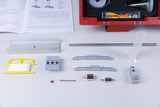
- 2 × Storing Tray shallow, red
- 1 × Leaf spring with bore
- 1 × Lid with bore for suction flask
- 2 ×
- 1 × Weight set for beam balance
- 1 × Weight holder, 10 g
- 1 × Rubber stopper 13/9 mm
- 1 × Rubber stopper 18/14 mm, 1 hole 8 mm
- 1 × Support clip, 8 mm Ø, on rod
- 2 × Holding clip on rod, 15 mm
- 1 ×
- 5 × Tubular clips, 5 mm
- 2 × Lid
- 2 ×
- 1 × Dynamometer, 1 N
- 1 × Plastic beaker, 250 ml, with scale
- 2 ×
- 1 × Plastic box 140/50/35 mm
- 1 × Water dish
- 1 × Coloring agent blue (food color)
- 1 × Pulley, unmounted, 43 mm dia. with hook
- 1 × Balloons with reinforced surface tension
- 1 × Air-cushion disc
- 1 × Carriage with friction foil, with weight and threaded rod
- 1 × Measuring cylinder, PP, 25 ml
- 2 × Metal axle, 50 mm
- 1 × Metal axle, 80 mm
- 1 ×
- 2 × Double clamp with slot, aluminium
- 1 × Profile rail, 180 mm
- 1 × Profile rail with drill hole, 360 mm
- 1 × Test tube, 100 mm, plastic
- 1 × Pulley, unmounted, 28 mm dia.
- 1 × Pulley, unmounted, 43 mm dia.
- 1 × Suction flask
- 1 × Paddle wheel
- 2 × Slotted mass, 10 g
- 3 × Slotted mass, 10 g
- 1 × Slotted mass, 50 g
- 1 × Slotted mass, 50 g
- 1 × Helical spring, 150 mm, 10 N
- 1 × Silicone tubing, 7/1,5 mm
- 1 × Tread on spool
- 2 ×
- 1 ×
- 1 ×
- 2 × Scale plan, yellow, with bows
- 1 × Carton for SEG (large tray)
- 1 × Set of 2 retaining rings
- 1 × Foam insert 1 for 43000, 415x310x65 mm
- 1 × Foam insert 2 for 43000, 380x270x50 mm
- 2 × SEG Lidfoam, grey 10 mm
- 1 × Rising tube, flexible
- 1 × U-shaped tube, perspex
- 2 ×
- 2 ×
- 1 ×
- 2 ×
- 4 ×
- 1 ×
- 1 ×
- 1 ×
- 2 ×
- 4 ×
- 1 ×
- 1 ×