Mini Box Magnetism/Electrostatics
Investigating Magnetic Forces and Electrostatic Phenomena Experimentally
Age: 8–14 years
Material: For 1 working group or demonstration
Use: Experiments on magnetism, magnetic fields, magnetic forces, static electricity, polarization and electrostatic induction
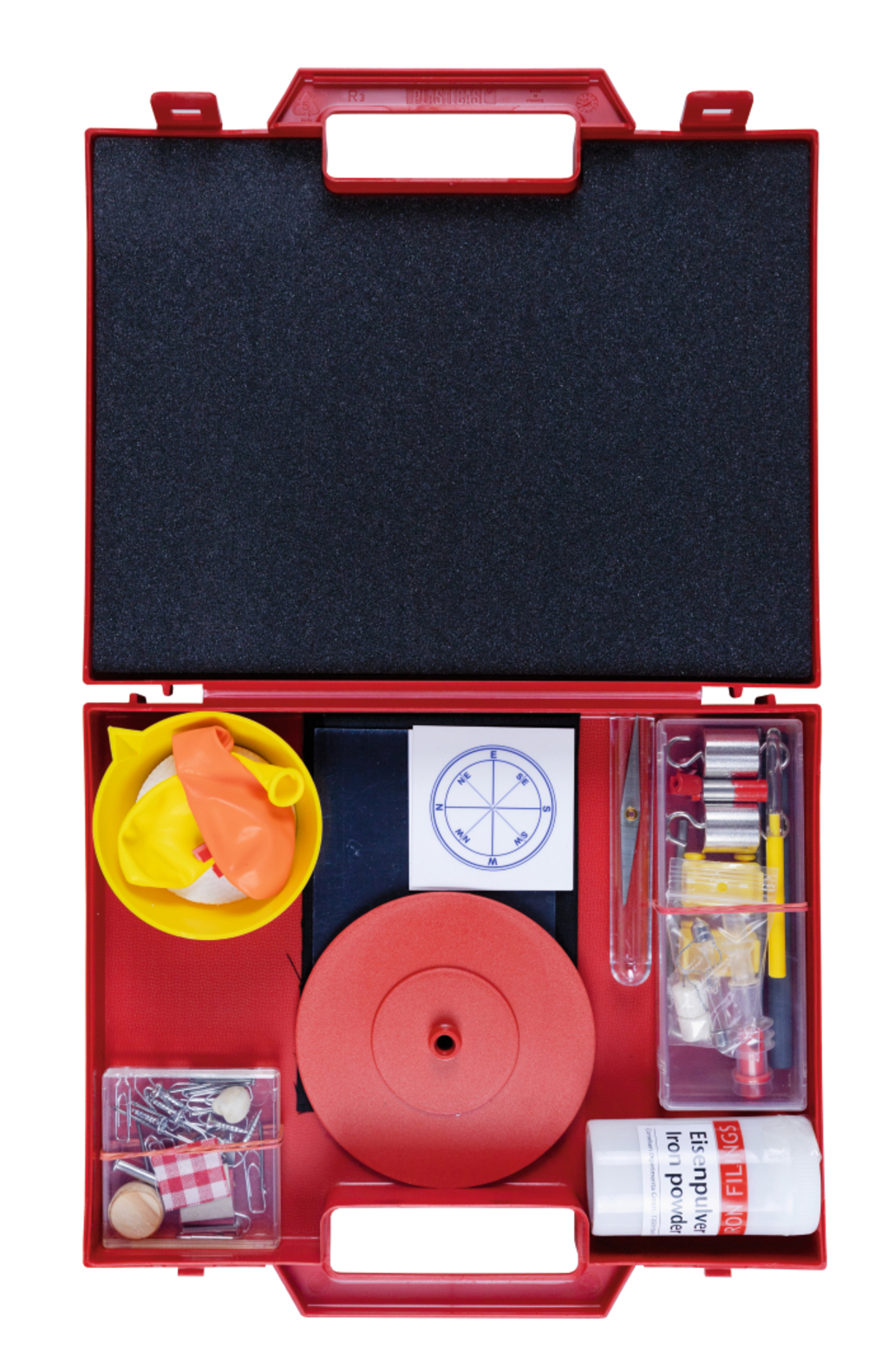
With the Mini Box Magnetism/Electrostatics, students investigate fundamental phenomena of magnetism and electrostatics through hands-on experiments. The set is suitable for one working group and can also be used for classroom demonstrations.
The experiments on magnetism cover topics including magnetic and non-magnetic materials, magnetic forces and field lines, the behaviour of different magnets and the Earth's magnetic field. Students can also investigate how to make a magnet and explore a simple magnetic motor.
In the field of electrostatics, students investigate static electricity, forces between charged objects, polarization and electrostatic induction. Further experiments demonstrate electrostatic phenomena using a charged balloon and a model electroscope.
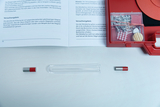
The equipment includes magnets, a compass needle, iron powder, a compass rose plate, pith pendulum, friction cloth and acrylic sheet. The included instructions describe a total of 17 experiments. All materials are stored neatly in a compact plastic case.




Technical specifications
Size of kit: 270 x 210 x 50 mm
We will shortly provide you with a description of the experiment at this point.
We will shortly provide you with a description of the experiment at this point.
We will shortly provide you with a description of the experiment at this point.
We will shortly provide you with a description of the experiment at this point.
We will shortly provide you with a description of the experiment at this point.
We will shortly provide you with a description of the experiment at this point.
We will shortly provide you with a description of the experiment at this point.
We will shortly provide you with a description of the experiment at this point.
We will shortly provide you with a description of the experiment at this point.
We will shortly provide you with a description of the experiment at this point.
We will shortly provide you with a description of the experiment at this point.
We will shortly provide you with a description of the experiment at this point.
We will shortly provide you with a description of the experiment at this point.
We will shortly provide you with a description of the experiment at this point.
We will shortly provide you with a description of the experiment at this point.
We will shortly provide you with a description of the experiment at this point.
We will shortly provide you with a description of the experiment at this point.
- 1 ×
- 1 ×
- 1 × Screen translucent, plastic
- 1 × Floating platform
- 1 × Clamp socket, 10 mm
- 2 × Magnet rod AlNiCo, north pole marked red
- 1 × Compass card
- 1 ×
- 1 × Test tube, 100 mm, plastic
- 1 × Needle support
- 2 × Tubular clips, 5 mm
- 1 ×
- 1 × Metal axle, 110 mm
- 1 × Friction rod
- 1 ×
- 1 × Water basin, plastic, 80 mm dia.
- 1 × Caster with iron powder
- 1 × Balloons with reinforced surface tension
- 1 × Friction rubber, wool
- 1 × Lidfoam R3, grey 260x200x10 mm
- 2 × Foam cutting, green, 145 x 80 x 20 mm
- 1 × Air cushion disc with bore 8/6 mm
- 1 ×
- 1 ×
- 2 ×
- 2 ×
- 1 ×
- 2 ×
- 1 ×