Demonstration kit Wind energy
Investigating Wind Energy Conversion, Storage and Performance
Use: Demonstration experiments on wind energy, energy conversion, wind generators, electrical power and energy storage in physics lessons
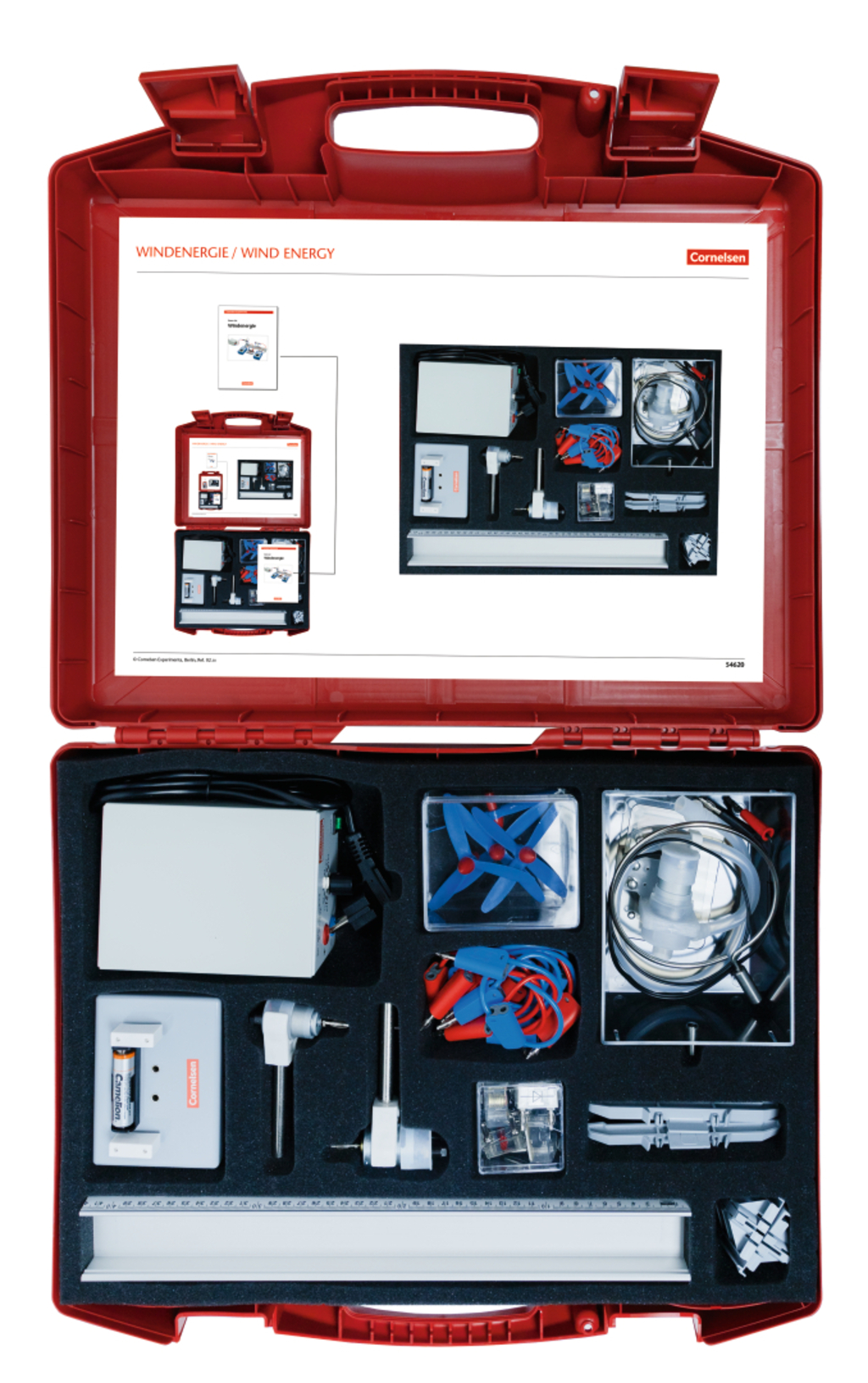
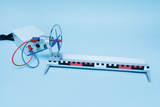
With the Demonstration kit Wind energy, you can teach fundamental principles of using wind as an energy source through practical experiments. The kinetic energy of moving air is first converted into mechanical rotational energy and then into electrical energy by the generator.
The experiments allow students to systematically investigate different factors that influence energy generation. These include wind speed, wind direction, the number of rotor blades and the load on the wind generator. Different rotors with two, three and four blades allow direct comparisons between different configurations.
Students can also investigate the power output of the wind generator and determine how different resistances and loads affect the electrical power generated. Another experiment focuses on storing the generated electrical energy in a rechargeable battery.
The practical use of wind energy can also be investigated. In combination with a pump, students can examine how the energy generated by the wind generator can be transferred to a technical application.



In this experiment, students learn about air flow.
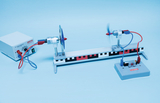
In this experiment, the flow energy of the air is first converted into rotational energy by the rotor blades and this in turn is converted into electrical energy in the generator.
We will shortly provide you with a description of the experiment at this point.
In this experiment, the increase of the supplied electric energy is observed due to the influence of the wind speed at the wind generator.
In this experiment, the students investigate the influence of the wind direction.
Students observe the behavior of a wind generator by turning a light bulb on and off.
In this experiment, the students investigate the influence of the rotor blades on the voltage generated.
In this experiment, the students determine the resistance and power values of the wind generator and can find out at which resistance values and at which load the maximum power of the wind generator can be output.
Students investigate when an accumulator has stored enough energy to light a light bulb.
In this experiment, the students investigate the use of wind energy. The practical use of such combinations of wind generators and water pumps lends itself to the irrigation and drainage of agricultural land and the storage of water in elevated tanks.
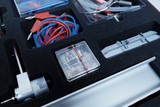
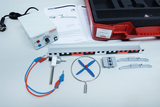
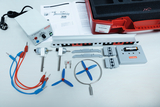
- 1 × Power supply unit, 1 to 6 V/2.5 A DC
- 1 × Bulb, MES, 1,5 V/0,15 A set of 10 pcs.
- 1 × Generator, on a rod
- 1 ×
- 1 × Plastic box, 105/90/50 mm
- 1 × Silicium diode, plug-in-element
- 1 × NiCd-Accu rechargeable 1,2 V, 0,5 Ah, KR 15/51
- 2 ×
- 1 × Base for plug-in elements and battery cell holder
- 1 ×
- 4 × Plug lead 25 cm, blue
- 1 × LED plug element
- 1 × Resistor, variable 100 Ohm plug-in element
- 1 × Rotor wih 2 blades and 4 mm bushing
- 1 × Rotor wih 3 blades and 4 mm bushing
- 2 × Rotor with 4 blades
- 1 ×
- 4 × Plug lead 25 cm, red
- 1 × Lamp Holder MES
- 1 × Plastic box 60x60x30 mm
- 1 × Foam insert for 54620, 515x360x110mm
- 1 × Foam insert grey, knobbed515x360x30 mm
- 1 × Water bassin, transparent
- 1 × Storing diagram,int.vers.(Wind energy)
- 1 × Ring on rod, 110 mm Ø(i)
- 1 × Rail, 420 mm
- 2 ×