Students kit Electricity Basic circuits
Building, Measuring and Understanding Electrical Circuits
Number of students: 2–3 students
Use: Student experiments on electric circuits, series and parallel circuits, current, voltage, resistance and electrical power
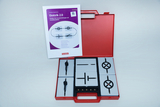
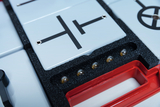
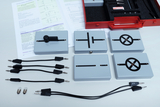
With the Students kit Electricity Basic circuits, 2–3 students can independently investigate fundamental principles of electricity. The robust component bases are printed with the corresponding circuit symbols, allowing students to directly relate the real experimental setup to its circuit diagram.
The experiments range from simple electric circuits and investigations of conductors and insulators to series, parallel and logic circuits as well as measurements of current and voltage. Further experiments cover Ohm’s law, the electrical resistance of a conductor, Kirchhoff’s laws and electrical power.
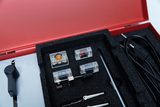
A special feature of the kit is the included graphite pencil. Students can draw conductive lines directly onto paper and measure them to investigate electrical resistance. The experiments can be powered either by batteries or by a power supply. The battery holder also allows experiments to be carried out away from the laboratory.
The component bases are magnetic, allowing the kit to also be used for demonstrations on suitable magnetic surfaces. Student worksheets are available as editable Word files. Additional teaching materials include support cards for circuit symbols and connecting measuring instruments, ten stations covering circuits used in the home, and additional exercises.
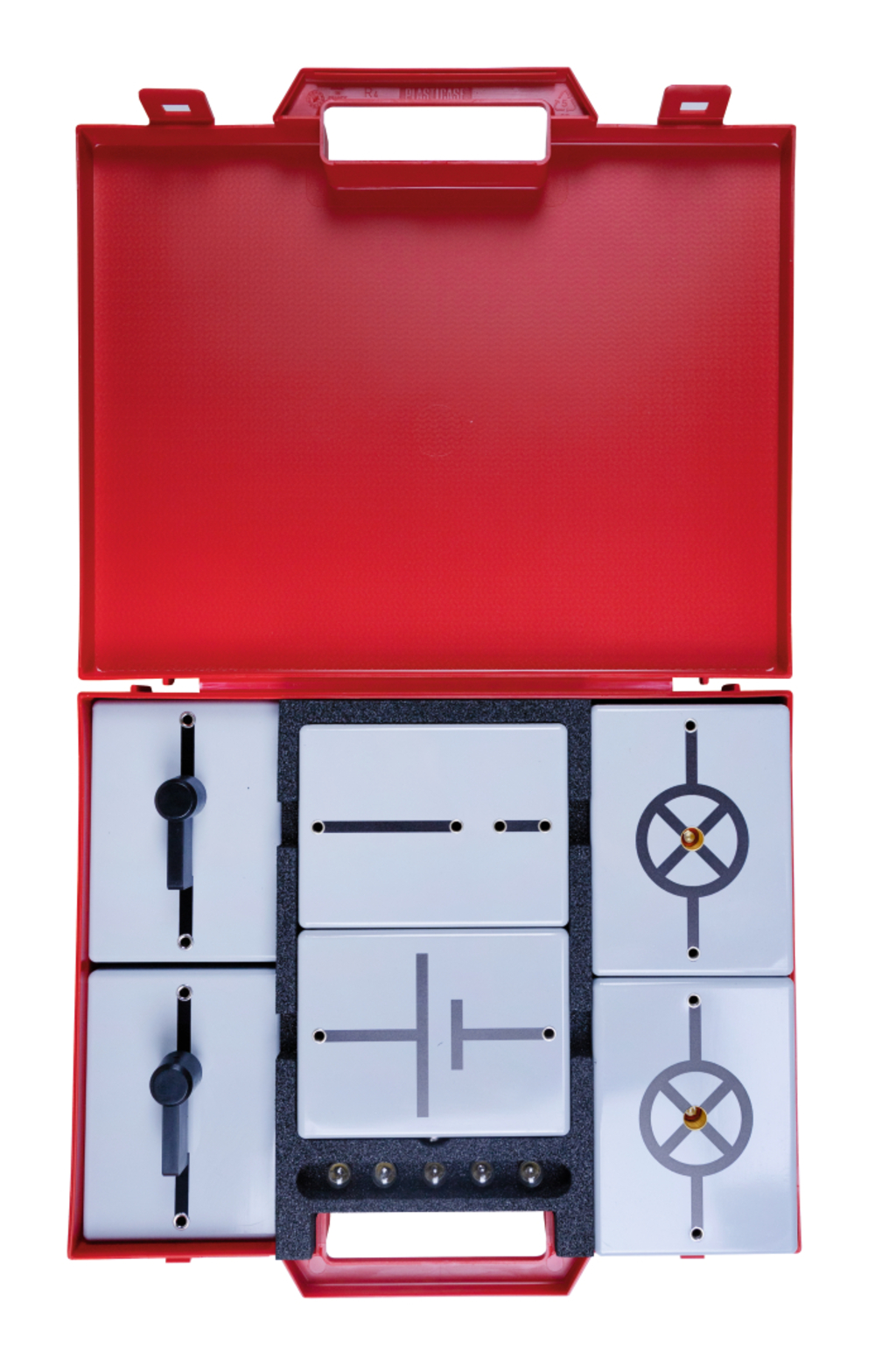


The first simple circuit is to be built. In doing so, the basic properties and important components are familiarized.
The conductivity of various materials and objects is qualitatively investigated.
The series and parallel connections are qualitatively investigated on the basis of the brightness of lamps. The experiment forms the basis for logical circuits and measurements in branched and unbranched circuits.
The two simplest logical circuits are to be developed independently. They also serve as preparation for the household circuits.
Simple electrical circuits from practice are to be reproduced at nine different stations. The focus is on the multiple application of series and parallel connections of switches and lamps.
In a simple circuit, the current is measured at different points.
The characteristic curve of an incandescent lamp and an ohmic resistance are measured and evaluated.
The experiment investigates which factors besides temperature have an influence on the resistance of a wire. Instead of a wire, graphite lines are examined on conventional and therefore poorly conducting paper.
Kirchhoff's laws are derived by the measurement of voltage and current and the calculation of the resistance.
Several puzzle tasks stimulate thinking. The terms series and parallel connection are practiced and competencies in the construction of electrical circuits are consolidated.
In a series connection with two lamps, the voltage is measured and evaluated between different points.
The electrical power is examined based on the brightness of lamps and the proportionality to current and voltage is discovered.
- 2 × Crocodile clip with 4 mm plug
- 1 ×
- 1 × Lever switch arm with plug
- 1 × Lamp Holder MES
- 1 × Resistor, 100 Ohms, plug-in element
- 1 ×
- 2 × Switch element, magnet adhering
- 2 × Bulb holder element MES, magnet adhering
- 5 × Plug lead, 10 cm, black
- 1 × Power supply element
- 1 × AA battery, 1.5 V, alkaline
- 1 × Light bulb, E10, 2.5 V / 0.2 A
- 2 × Plug lead, 25 cm, black
- 1 × Resistor, 10 Ohms, plug-in element
- 1 × LED plug-in-element, red
- 1 × Lever switch contact with plug
- 1 ×
- 1 ×
- 1 ×