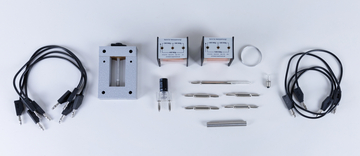
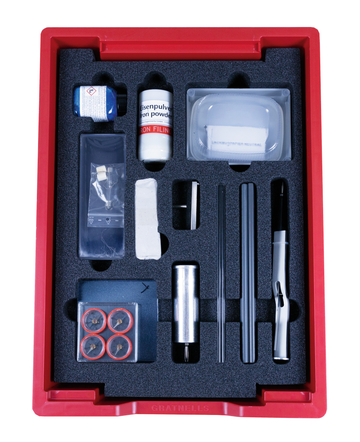
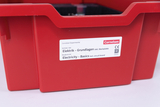
Students kit Electricity – Basics including circuit board
Build basic electrical circuits and teach fundamental principles of electricity
Use: Student experiments on basic electrical circuits and the effects of electric current
With the Students kit Electricity – Basics including circuit board, you can teach key topics of electricity in a clear and hands-on way. Designed for physics lessons in grades 5 to 10, the set enables students to build basic electrical circuits independently and investigate how they work through practical experiments.
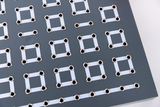
Using the included circuit board, students can set up different circuits in a clear and structured way. They explore electric current, basic types of circuits and the effects of electric current. Topics such as thermal energy and electromagnetism can also be investigated through hands-on experiments.
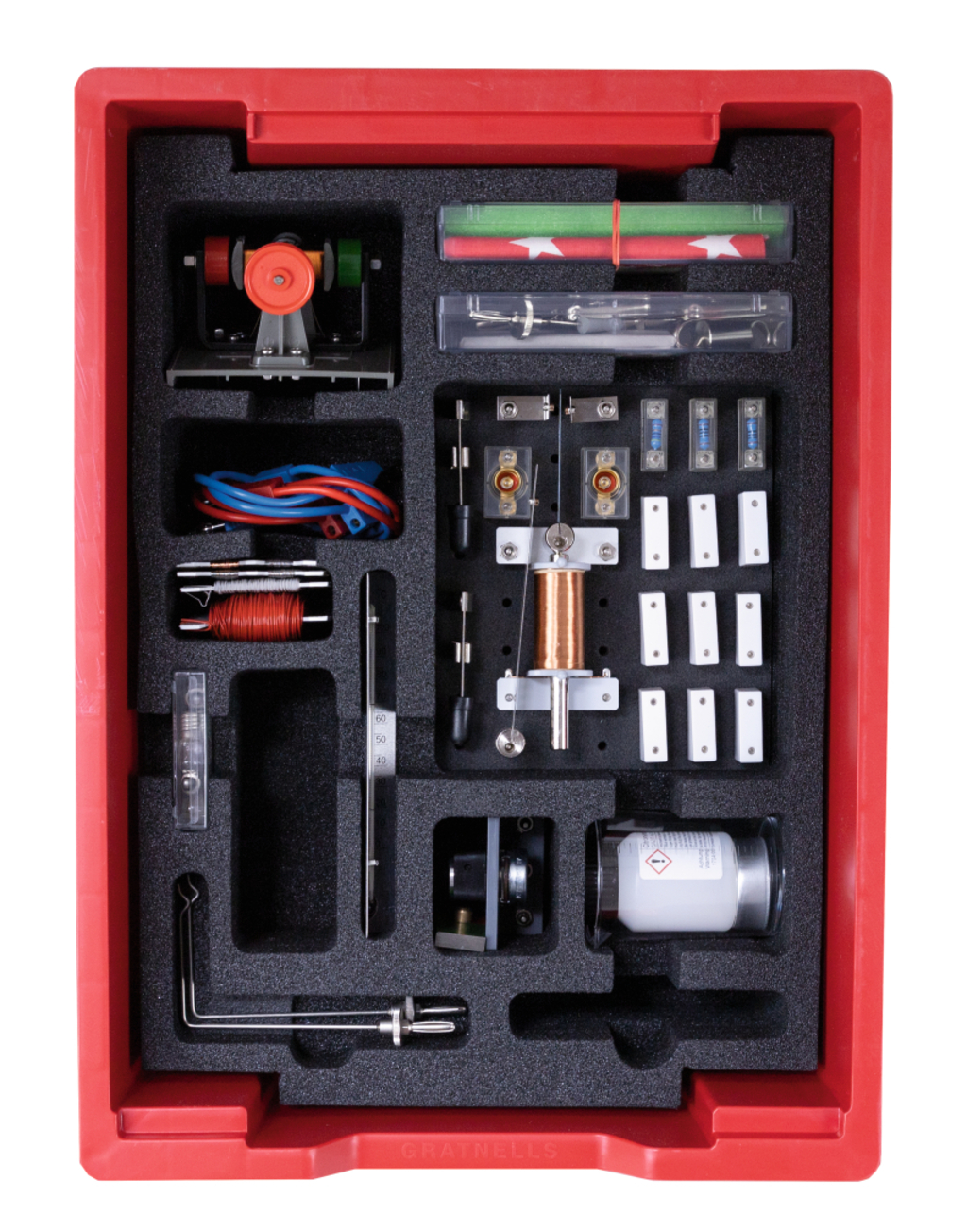
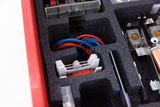
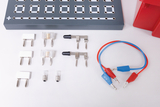
The components of the basic set are clearly arranged and stored in a sturdy plastic tray, keeping the equipment organised and ready for classroom use.
If you would like to cover electricity in greater depth, the Students kit Electricity including circuit board, is the complete solution. In addition to this basic set, the complete set also includes the two supplementary sets 23220 Induction and AC Voltage and 23230 Electrostatics, Magnetism and Electrochemistry, providing all three trays
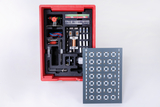
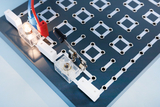
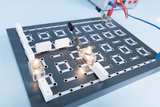
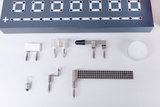
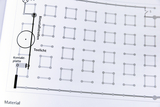
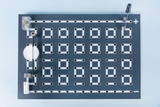
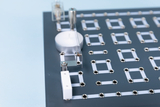


The students build an electrical circuit.
Test to determine the conductivity of different substances.
Students examine the power line of various liquids.
In the experiment, it is observed what differences there are in the voltage when one or more incandescent lamps are switched on.
This experiment shows the effect of resistance on the current and the lamp associated with it.
This experiment shows the effect of resistance on the current and the lamp associated with it.
The experiment shows the relationships between the quantities U=voltage, I=current and R=resistance.
In this experiment, the series connection of resistors is investigated.
The experiment investigates the effect of resistors, in a parallel connection, on the current.
The experiment shows the effect of an adjustable resistance on an incandescent lamp.
In this experiment it is observed what effect it has on a lamp when the voltage changes.
This experiment is for measuring specific resistances of different materials.
This experiment examines the conductivity of a wire when it is cold and when it is heated.
In this experiment, the system of a bridge circuit and its effect on the voltage of an incandescent lamp will be explained to you.
In this experiment, the resistance measurement is examined using an ammeter.
The experiment shows to what extent a parallel connection or a series connection influences the electrical output.
In this experiment, the heat development of a current-carrying heating wire is observed.
This experiment illustrates how electrical energy is converted into thermal energy.
This experiment shows how electrical energy is converted into light, like an incandescent lamp.
The experiment deals with the structure of a circuit, with a bimetallic switch, and its influence on the circuit.
In this experiment, the position of a hooked weight is observed, which is suspended from a current-carrying conductor. From the observations, conclusions are drawn about the change in the position of the hook weight.
In this experiment, the effect of the magnetic field of a conductor is observed.
This experiment shows the effect of an electromagnet and is compared with that of a permanent magnet.
In this experiment, the effect of the relay is observed.
This experiment shows the structure of a self-interrupter, how it works and what processes take place in it.
This experiment illustrates the principle of an electric motor and how it works.
By applying a voltage to the electric motor, you get a rotary movement.
Here, electrical energy is converted into mechanical energy.
It is investigated what difference there is when connecting several incandescent lamps in a row and what effects this has on the current.
In this experiment, the parallel connection of incandescent lamps is investigated and what effect this has on the circuit.
In this experiment, the difference between a power and a resistance wire is examined.
The experiment shows how a fuse works and makes sense in a circuit.
- 2 × Plug lead 25 cm, blue
- 2 × Resistor, 100 Ohms, plug-in element
- 1 × Coil with core and plugs
- 1 × Bulb, MES, 1,5 V/0,15 A set of 10 pcs.
- 1 × Bulb 3,8 V / 0,07 A
- 2 × Crocodile clip with 4 mm plug
- 1 × Pair of contact plates with plugs
- 1 ×
- 2 × Carbon electrode
- 1 × Lid
- 1 ×
- 1 × Copper wire with insulation
- 9 × Bridge plug
- 1 × Graduated plastic beaker, 100 ml
- 1 × Bulb, MES, 6 V/0,3 A set of 10 pcs.
- 2 × Plug lead 25 cm, red
- 2 × Support bail with plug
- 1 ×
- 2 × Lever switch arm with plug
- 1 × Bimetallic strip on plug
- 1 × Heating wire, covered, 0,20 mm Ø
- 1 ×
- 1 × Needle support with plug
- 1 × Flat bar magnet
- 1 × Resistor, 50 Ohms, 1 W plug-in element
- 1 × Thermometer student type –5 to +100 °C
- 1 × Electric motor with plugs
- 1 × Storing Tray deep, red
- 1 ×
- 1 × Citric acid
- 2 × Lever switch contact with plug
- 1 × Material patterns, set of 14
- 2 × Lamp Holder MES
- 1 × Universal circuit board
- 1 × Foam insert for 23210 390/275/105 mm
- 1 × SEG Lidfoam, grey 10 mm
- 1 × Foam insert with bores, 160/140/20mm
- 1 ×
- 1 ×
- 1 ×
- 1 ×