Students kit Everyday electricity and magnetism
Practical Experiments on Electric Circuits, Charges and Magnetism
Grade level: 5–8
Number of students: 1 working group
Use: Student experiments in one working group or demonstration experiments
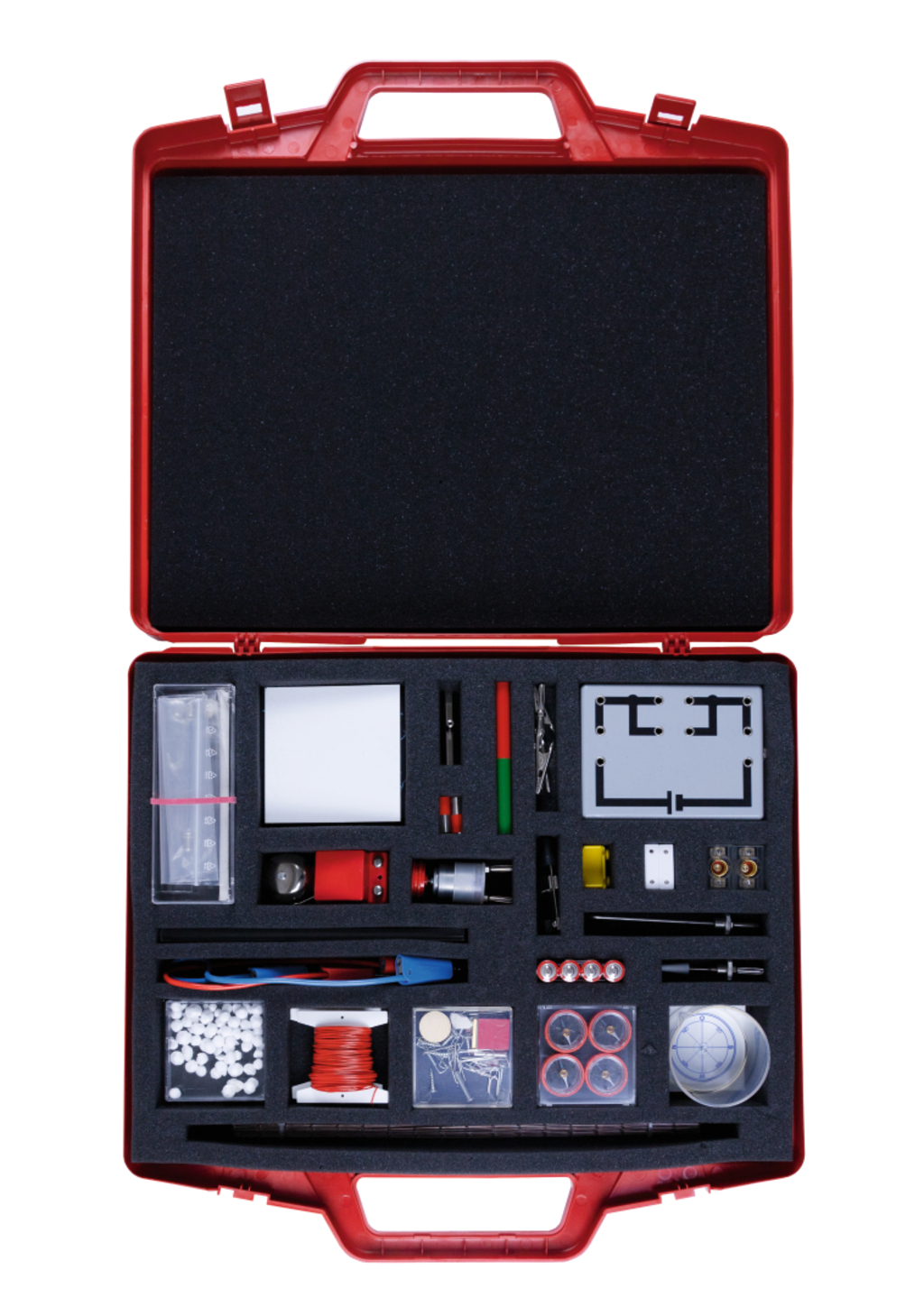
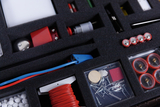
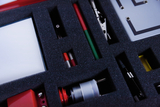
The Students kit Everyday electricity and magnetism combines fundamental topics from electricity and magnetism for integrated science lessons. Students carry out experiments independently and become familiar with basic electrical and magnetic phenomena.
The experiments cover electric current and basic electric circuits, the effects of electric current, and the detection and behaviour of electric charges. Another focus is on the properties of permanent magnets and the relationship between electricity and magnetism.
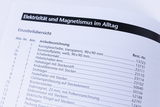
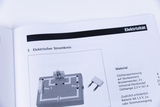
A comprehensive teacher's guide includes experiment descriptions and examples of questions for evaluating the experiments, supporting their use in the classroom.
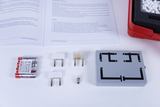
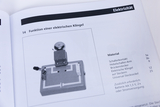
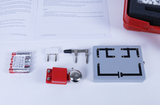


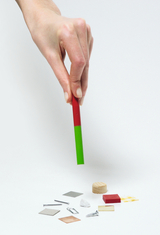



In this experiment, a rubbed sheet of art glass is approximated to spheres of Styrofoam.
Der Versuch zeigt, was beom Öffnen und Schließen eines elektrischen Stromkreises passiert.
In this experiment, the students can find out whether liquid substances have electrical conductivity.
In this experiment, one examines the parallel connection of incandescent lamps and their effects when the switch is closed.
In this experiment, one examines the series connection of incandescent lamps and their effects when the switch is closed.
Students investigate the magnetization of iron wire with a bar magnet.
Students build a small model compass and observe the difference between a bar magnet and a magnetic needle.
In this experiment, one observes the behavior of the elderberry pith pieces when the retaining bar is touched several times by the grated plastic rod.
In this experiment, one observes the behavior of the elderberry pith pieces when the retaining bar is touched several times by the grated plastic rod.
The experiment shows an electric circuit to make a light bulb glow.
In this experiment, the students can find out whether solid materials have electrical conductivity.
The experiment deals with the circuit of voltage sources.
What happens to the heating effect of the electric current? What changes are there in the heating wire after the switch is closed?
This experiment investigates the magnetic effect of electric current with reference to everyday use.
The students can observe the function of the electric bell in this experiment.
The students build a small electric motor and investigate its function.
The students investigate the magnetic effect with different materials.
In this experiment, the students can observe the transmission of the magnetic effect. What can be observed when a bar magnet with an attached iron plate approaches an iron nail?
The students observe what happens to a rotating bar magnet when approached with a short bar magnet.
In this experiment, students find out when and why a magnet can levitate.
In this experiment, one can investigate whether pieces of iron wire approach each other.
The students investigate the behavior of the magnetic needles in the compasses with a bar magnet.
- 1 ×
- 1 × Screen translucent, plastic
- 1 × Friction rubber, wool
- 1 × Magnet rod AlNiCo, one each half painted red and green
- 1 × Lever switch arm with plug
- 1 × Metal axle, 110 mm
- 1 ×
- 1 × Needle support with plug
- 1 ×
- 1 × Test tube, 100 mm, plastic
- 1 × Plug lead 25 cm, red
- 1 ×
- 1 × Screen white, plastic
- 1 × Plug lead 25 cm, blue
- 1 × Support bail with plug
- 1 × Pivot bearing for friction rods and magnets
- 1 × Electric motor with 4 mm plugs
- 2 × Stand rod, plastic
- 1 ×
- 1 × Heating wire, covered, 0,20 mm Ø
- 1 × AA battery, 1.5 V, alkaline
- 1 × Copper wire with insulation
- 1 × Bulb,MES, 2,5V/0,1A clearset of 10 pcs.
- 2 × Bridge plug
- 1 × Plastic box 140/50/35 mm
- 1 × Lever switch contact with plug
- 2 × Crocodile clip with 4 mm plug
- 1 × Styrofoam balls
- 1 × Set of (4) compasses
- 2 × Magnet rod AlNiCo, north pole marked red
- 1 × Plug-in element base
- 1 ×
- 1 × Magnetic needle 75 mm
- 2 × Lamp Holder MES
- 1 × Iron wires w. notches pack of 100
- 1 × Glow lamp, big size
- 1 × Foam insert, 430x320x40mm
- 1 × Plastic tube, transparent
- 1 × Foam insert for 22006 426x325x65 mm
- 1 × Carton for storage box, 481x425x107
- 1 ×
- 2 ×