Students kit Fundamental physics
The equipment in this kit makes it possible to conduct 96 fundamental experiments on the topics of mechanics, energy, heat, acoustics, optics and electricity. The key focus is on understanding the effects of physical laws and the precise
measurement of physical quantities.
The selection of individual components has been made under the consideration that they can be used in as many functions as possible.
The experiments can be set up with the help of the clear experiment instructions in such a way that they are guaranteed to function properly.
No additional materials or equipment are necessary. The equipment in the kit can also be used outside a laboratory.
Detailed instructions for 96 experiments for the following topics:
• Mechanics of solid bodies / 17 Experiments
• Mechanics of fluids / 11 Experiments
• Mechanics of gases / 10 Experiments
• Heat / 9 Experiments
• Sound / 5 Experiments
• Light / 16 Experiments
• Magnetism / 8 Experiments
• Electricity / 20 Experiments
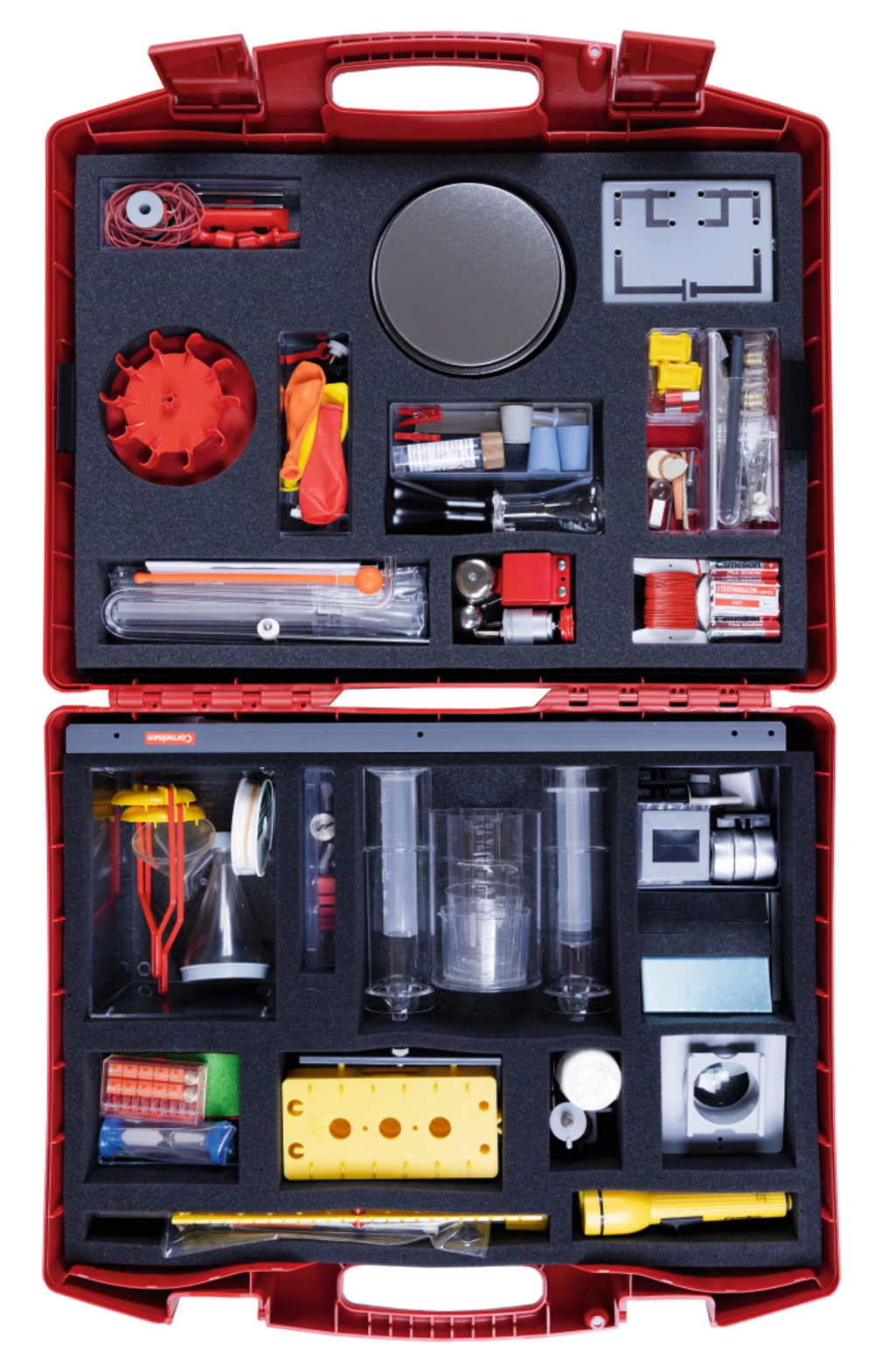


Technical specifications
Size of kit: 540 x 450 x 150 mm
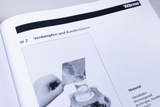
The students determine the volume of a solid.
This experiment examines force measurement.
The students measure the pendulum oscillations using a homemade pendulum.
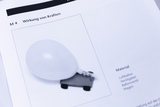
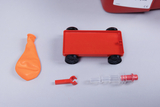
Using a balloon, balloon valve, trolley and valve fork, students can investigate the effect of forces.
The students observe the inertia of the mass with the help of a steel ball.
How does a two-sided lever work? With the help of a profile rail, a balance and a force gauge, the students can investigate and find out.
This experiment shows how a spring force gauge works and the relationship between the mass of a body and the force exerted.
A beam balance can be used to compare an unknown mass of a body with a known mass of a weight.
The students build a running weight scale and learn the difference to a beam scale.
In this experiment, the students investigate the properties of the fixed roller.
In this experiment, the principle of the pulley is investigated.
How does the water level in a beaker behave if you tilt it sideways a little?
Two filter tubes are connected to each other and filled with liquid. The students observe what happens when they are stationary and what happens when a filter tube is lowered.
What happens when you fill a beaker with liquid and immerse a capillary tube vertically?
We will shortly provide you with a description of the experiment at this point.
The students investigate the pressure distribution in liquids using a suction bottle and a hose.
In this experiment, pressure is applied to a liquid that is in an enclosed space.
Students investigate the buoyancy of liquids by immersing them in water.
In this experiment, students learn about Archimedes' law.
Using an Erlenmeyer flask, students investigate swimming, floating, and sinking.
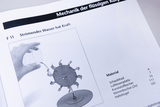
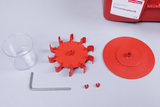
Using a paddle wheel, students can observe that water has power.
This experiment shows that air is a body.
This experiment investigates the fact that trapped air can be compressed, but can also expand.
The students build a U-tube manometer and observe the water column when pressure is applied in a suction bottle.
What happens when gases heat up or cool down? In this experiment, the students can immediately observe the changes in volume when a gas heats up and cools down.
This experiment shows the positive and negative pressure of the trapped air in the U-tube.
In this experiment, a suction bottle with a funnel is placed in a tub filled with water. Air is now pulled out with the help of a syringe. The students observe what happens now and learn how a suction hook works.
The students learn about the model of a spray bottle.
In this experiment, a balloon is filled with air using a balloon valve and placed on an air cushion plate. The students observe what happens when the valve is opened.
An inflated balloon is held over a paddle wheel with the balloon valve. The valve is then opened and the students observe the paddle wheel.
We will shortly provide you with a description of the experiment at this point.
We will shortly provide you with a description of the experiment at this point.
We will shortly provide you with a description of the experiment at this point.
We will shortly provide you with a description of the experiment at this point.
We will shortly provide you with a description of the experiment at this point.
We will shortly provide you with a description of the experiment at this point.
We will shortly provide you with a description of the experiment at this point.
We will shortly provide you with a description of the experiment at this point.
We will shortly provide you with a description of the experiment at this point.
We will shortly provide you with a description of the experiment at this point.
We will shortly provide you with a description of the experiment at this point.
We will shortly provide you with a description of the experiment at this point.
We will shortly provide you with a description of the experiment at this point.
We will shortly provide you with a description of the experiment at this point.
We will shortly provide you with a description of the experiment at this point.
We will shortly provide you with a description of the experiment at this point.
We will shortly provide you with a description of the experiment at this point.
We will shortly provide you with a description of the experiment at this point.
We will shortly provide you with a description of the experiment at this point.
We will shortly provide you with a description of the experiment at this point.
We will shortly provide you with a description of the experiment at this point.
We will shortly provide you with a description of the experiment at this point.
We will shortly provide you with a description of the experiment at this point.
We will shortly provide you with a description of the experiment at this point.
We will shortly provide you with a description of the experiment at this point.
We will shortly provide you with a description of the experiment at this point.
We will shortly provide you with a description of the experiment at this point.
We will shortly provide you with a description of the experiment at this point.
We will shortly provide you with a description of the experiment at this point.
We will shortly provide you with a description of the experiment at this point.
We will shortly provide you with a description of the experiment at this point.
We will shortly provide you with a description of the experiment at this point.
We will shortly provide you with a description of the experiment at this point.
We will shortly provide you with a description of the experiment at this point.
We will shortly provide you with a description of the experiment at this point.
We will shortly provide you with a description of the experiment at this point.
We will shortly provide you with a description of the experiment at this point.
We will shortly provide you with a description of the experiment at this point.
We will shortly provide you with a description of the experiment at this point.
We will shortly provide you with a description of the experiment at this point.
We will shortly provide you with a description of the experiment at this point.
We will shortly provide you with a description of the experiment at this point.
We will shortly provide you with a description of the experiment at this point.
We will shortly provide you with a description of the experiment at this point.
We will shortly provide you with a description of the experiment at this point.
We will shortly provide you with a description of the experiment at this point.
This experiment investigates the stability and center of gravity of a body.
With the help of a profile rail, a trolley and a force gauge, the students can investigate and find out about friction.
How does a one-sided lever work? With the help of a profile rail, a trolley and a dynamometer, the students can investigate and find out.
In this experiment, the students observe the center of gravity using a homemade cardboard body.
In this experiment, the students investigate the properties of the loose roll.
A force is required to pull a body upwards on an inclined plane. In this experiment, the students find out why this is the case.
In this experiment, the surface tension between the water surface and the underside of an air cushion plate is investigated.
What happens if you put a plastic plate on top of a cup filled with water, turn them both over, and then lift them up?
We will shortly provide you with a description of the experiment at this point.
We will shortly provide you with a description of the experiment at this point.
We will shortly provide you with a description of the experiment at this point.
We will shortly provide you with a description of the experiment at this point.
We will shortly provide you with a description of the experiment at this point.
We will shortly provide you with a description of the experiment at this point.
We will shortly provide you with a description of the experiment at this point.
We will shortly provide you with a description of the experiment at this point.
We will shortly provide you with a description of the experiment at this point.
We will shortly provide you with a description of the experiment at this point.
We will shortly provide you with a description of the experiment at this point.
We will shortly provide you with a description of the experiment at this point.
- 1 × Beaker, 500 ml with 2 scales
- 1 × Pith ball pendulum
- 1 ×
- 1 × Copper wire with insulation
- 1 × Needle support with plug
- 1 × Triangular bridges
- 1 × Hearing tube
- 1 ×
- 2 × Plastic box 140/50/35 mm
- 1 ×
- 1 × Spools of string with dog-bone ends
- 1 ×
- 1 × Friction rod
- 1 × Prism, equilateral, 25 x 25 mm
- 1 ×
- 1 × Dynamometer, 1 N
- 2 ×
- 1 × Coloring agent blue (food color)
- 1 ×
- 1 × Angled stand base
- 1 ×
- 1 × Pulley, unmounted, 58 mm dia.
- 1 × Pulley with hook
- 1 × Carriage
- 3 ×
- 1 × Bulb,MES, 2,5V/0,1A clearset of 10 pcs.
- 1 × Screen translucent, plastic
- 1 ×
- 1 × Spring 100 mm / 12 N
- 1 × Friction rubber, wool
- 1 × Suction flask
- 1 ×
- 1 × Heating wire, covered, 0,20 mm Ø
- 1 × Plastic beaker, 100 ml
- 1 ×
- 1 × Tube coupling
- 1 ×
- 1 × Bulb 4V / 1 A
- 1 × Diaphragm with arrow
- 1 × Burner
- 1 × Screen white, plastic
- 1 ×
- 1 × Paddle wheel
- 1 × Balloons with reinforced surface tension
- 1 × Glass tubing, straight, 100 mm with jet
- 1 × Weight set for beam balance
- 1 × Mirror, plane, glass
- 2 × Bridge plug
- 1 × Needle support
- 1 × Syringe with nozzle, 30 ml
- 1 × Test tube, 100 mm, plastic
- 2 × Plastic box, 105/90/50 mm
- 1 ×
- 1 × Rubber stopper 24/19 mm
- 2 × Rubber stopper with 6 mm bore
- 1 × Heat protection gauze
- 1 × Plug-in element base
- 1 ×
- 1 × Glass tubing, straight, 200 mm
- 1 ×
- 1 × Measuring cylinder, PP, 25 ml
- 1 ×
- 1 × Silicone tubing, 7/1,5 mm
- 1 × Metal axle, 125 mm
- 1 × Bimetallic strip
- 1 × Erlenmeyer flask, Duran 25 ml
- 1 × Coil with core and plugs
- 1 ×
- 1 × Cord, demonstration, 1 mm dia.
- 1 × Ball, nickel-plated steel
- 1 × Beaker, Duran, tall form, 50 ml
- 2 × Magnet rod AlNiCo, north pole marked red
- 2 ×
- 3 × Cross base
- 1 × Floating platform
- 2 × Crocodile clip with 4 mm plug
- 1 × Lever switch arm with plug
- 1 × Lever switch contact with plug
- 2 × Lamp Holder MES
- 1 × Caster with iron powder
- 2 × Scale plan, yellow, with bows
- 4 × Tubular clips, 5 mm
- 1 ×
- 1 × Compass card
- 1 ×
- 1 × AA battery, 1.5 V, alkaline
- 1 ×
- 1 × Electric motor with 4 mm plugs
- 1 × Thermometer, student type –25 to +50 °C
- 1 × Sound box, 3 parts
- 2 × Cord stretcher
- 1 × Spring steel strip with oscillation head, 300 mm
- 1 × Lidfoam grey,515x355x10mm
- 1 ×
- 1 × Foam insert 1 for 16005, 505x355x35 mm
- 1 × Foam insert 2 for 16005, 515x350x85 mm
- 1 × Storing diagram,int.vers.(Fundamental Physics)
- 1 × Sand timer, 1 minute
- 1 × Beaker w. punctured base
- 1 × Tuning fork, 95 mm long not tuned
- 1 × Friction pad (foam) 95/45/10 mm
- 1 × Lever with three bores and clamp socket
- 2 × Clamp block
- 1 ×
- 3 ×
- 2 ×
- 1 ×
- 1 × U-shaped tube, perspex
- 1 × Metal plate, 150 mmØ
- 1 × Projection box, black
- 1 × Clamp, 14 mm Ø with notch
- 1 × Clamp, 25 mm Ø with notch
- 1 × Clamp, 8 mm Ø with notch
- 1 ×
- 1 × Slide holder
- 1 ×
- 2 ×
- 2 ×
- 2 ×
- 2 ×
- 2 ×
- 1 × Slit diaphragm 2/1
- 1 × Holding clip, 20 mm Ø, with notch
- 1 × Air cushion disc with bore 8/6 mm
- 1 ×
- 1 ×
- 2 ×