Students kit Sound and tone
Investigating Sounds, Vibrations and Sound Transmission
Age: 8–12 years
Materials: for up to 25 workstations, for at least 25 children
Use: Student experiments on sound generation, vibrations, pitch, volume, sound amplification and sound transmission, as well as the conscious perception, recognition and description of sounds
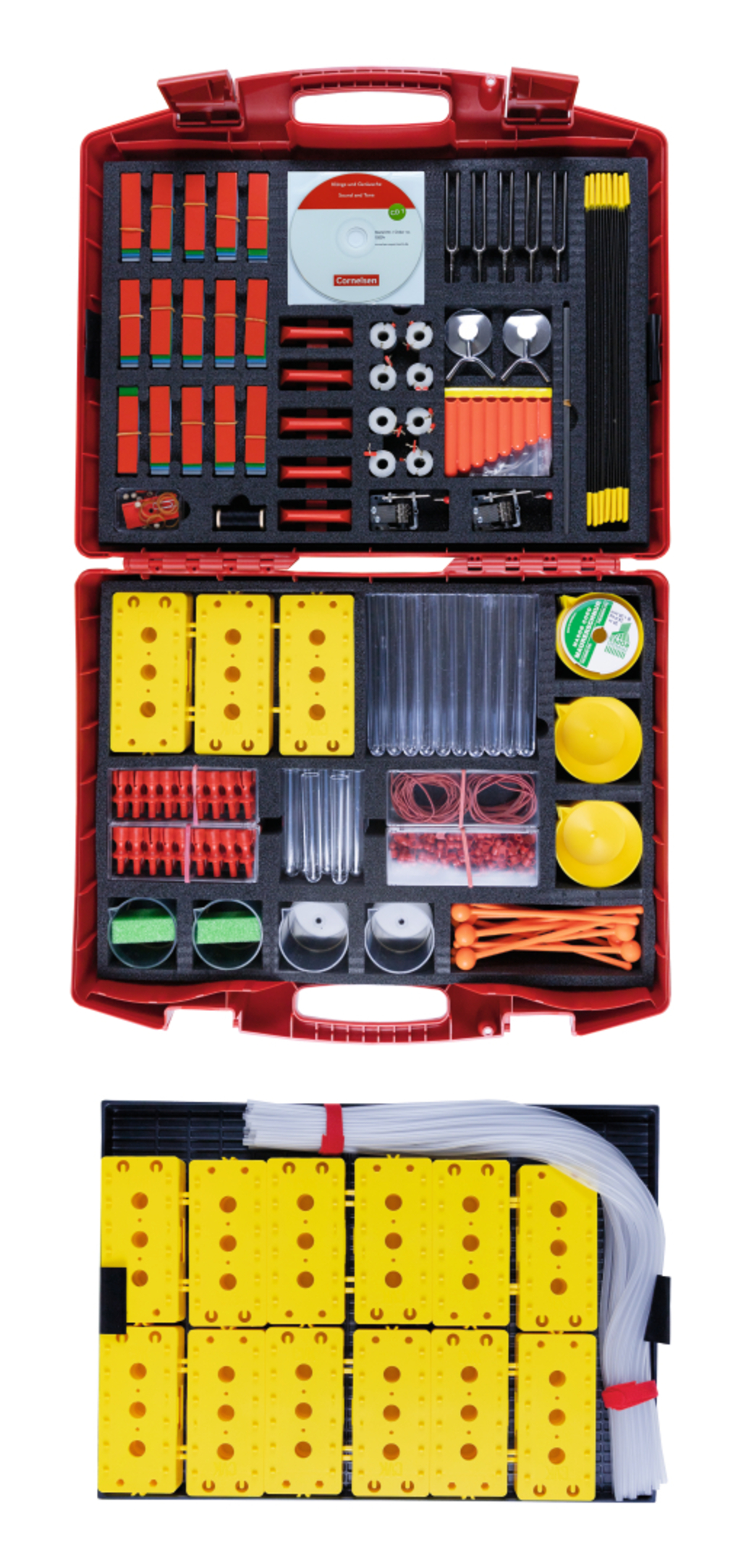
With the Students kit Sound and tone, students investigate fundamental phenomena related to sound, tones and noises. The materials are particularly suitable for station-based learning in pairs and can be used across science, music and language lessons.
Students discover that sound is produced by vibrations and investigate the factors that determine pitch and volume. Using a rubber-band zither, for example, they explore how the length, thickness and tension of a vibrating string affect its pitch. Test tubes can be used as a pan flute to demonstrate the relationship between the length of an air column and the tone produced.
Further activities focus on sound transmission and amplification. Experiments with strings, tubes, resonating bodies and a stethoscope demonstrate how sound can be transmitted and perceived. Students also investigate why having two ears is important for hearing.
Another focus is on listening carefully and describing sounds. Using the accompanying audio materials, students can recognise, name and match sounds, distinguish between similar sounds and recreate a sound story. The audio files are also available as downloads.
A teacher's guide with information on station-based learning and additional teaching and organisational guidance supports lesson preparation.














Technical specifications
Size of kit: 540 x 450 x 150 mm
The students match the different sounds on a sound CD.
Here, students match sounds and sound-naming verbs.
The students assign sound twins.
The students assign a sequence of sounds to a storyline.
The students use a tuning fork and can establish a connection between vibrations and sound through various experiments.
With these experiments, students can explore the connection between vibrations and sounds in a playful way.
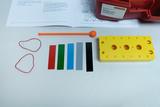
A rubber ring zither can be used to explore the relationships between "string" length, gauge and tension on the one hand and "tone" pitch on the other.
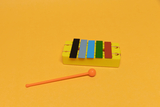
Students* assemble a carillon. The learning outcome of assembling and trying out the glockenspiel is the following insights: Of a set of plates, the longest sounds the lowest and the shortest sounds the highest.
The students use the test tubes as a pan flute.
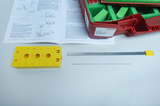
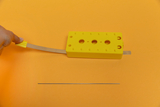
On the "thumb piano", the relationships between the length of the vibrating steel strip and the pitch can be tested quite "naturally".
With the combination music box / sound box you can experience how strongly the sound is amplified by a resonating body.
A corpus determines not only the volume, but also the sound of an instrument quite significantly, as it resonates in its own way.
The sound of a vibrating body (here a rubber ring) can be changed by a resonating body, although this is initially only noticeable in the volume.
The can does not "cackle", it only makes the vibrations on the string audible. To do this, it must be made to vibrate.
In this experiment, the soft tapping sounds on a soft tube are clearly perceived.
A string transmits sound stronger and faster than air, but only when it is taut. The students can observe this phenomenon with a can telephone.
A soft sound is audible. How does it reach the ear? The children soon find out that it must be the air. They may also have heard that you can't hear anything where there is no air (in space) - or conversely, that you can hear very well under water.
On the level of physics, this is about the transmission of sound - via the string held taut and the finger bones. Beyond that, however, there is much else to discover. For example, one can determine the different distance of the tuning forks and also the proximity to one of the two ears. Also, the sound of the tuning forks gets a completely different character when it is not conducted into the ear via the air, but via string and fingers (!).
The students can listen to heart sounds with the help of a stethoscope.
Children know from experience from swimming that you can hear well under water, but here the comparison is possible: you can hear the struck tuning fork vibrating in the water without a tube - using only the air as a transmitter - and through the tube.
- 1 ×
- 1 ×
- 4 × Plastic box 140/50/35 mm
- 1 × Spool of thread
- 15 × Test tube, 100 mm, plastic
- 2 ×
- 4 ×
- 15 × Sets of sound plates
- 15 × Water basin, plastic, 80 mm dia.
- 1 ×
- 3 × Pairs instrument strings for monochord
- 15 ×
- 8 × Spools of string with dog-bone ends
- 2 × Music box with crank handle
- 15 × Tuning forks, not tuned, length 105 mm
- 15 × Triangular bridges
- 30 ×
- 1 × Cord, demonstration, 1 mm dia.
- 30 × Hearing tube
- 2 × Stethoscope chest-piece
- 1 × Storing diagram,int.vers.
- 15 × Sound box, 3 parts
- 15 × Spring steel strip with oscillation head, 300 mm
- 36 × Cord stretcher
- 1 × Membrane slider
- 1 × Pan pipe, plastic
- 1 × Foam insert 2 for 31720, 515x370x70 mm
- 4 × Beaker w. punctured base
- 1 × Foam insert 1 for 31720, 505x355x30 mm
- 15 ×
- 20 ×
- 2 ×
- 5 ×
- 125 ×
- Set of 100 rubber rings for soundplates