Mini-Box Mechanics

Fundamentals of Mechanics: Forces and Motion

Use: Individual, partner and small-group work, particularly suitable for after-school programs, all-day learning, independent work and open learning environments.

With the Mini Box Mechanics, children explore fundamental mechanical phenomena through hands-on experimentation and discovery. They investigate forces, motion and simple technical principles, gaining practical experience with the fundamentals of mechanics.

The materials encourage independent experimentation and exploration and are suitable for individual, partner and small-group work. Thanks to its compact format, the Mini Box can be used flexibly in after-school programs, all-day learning, independent work and other open learning environments.
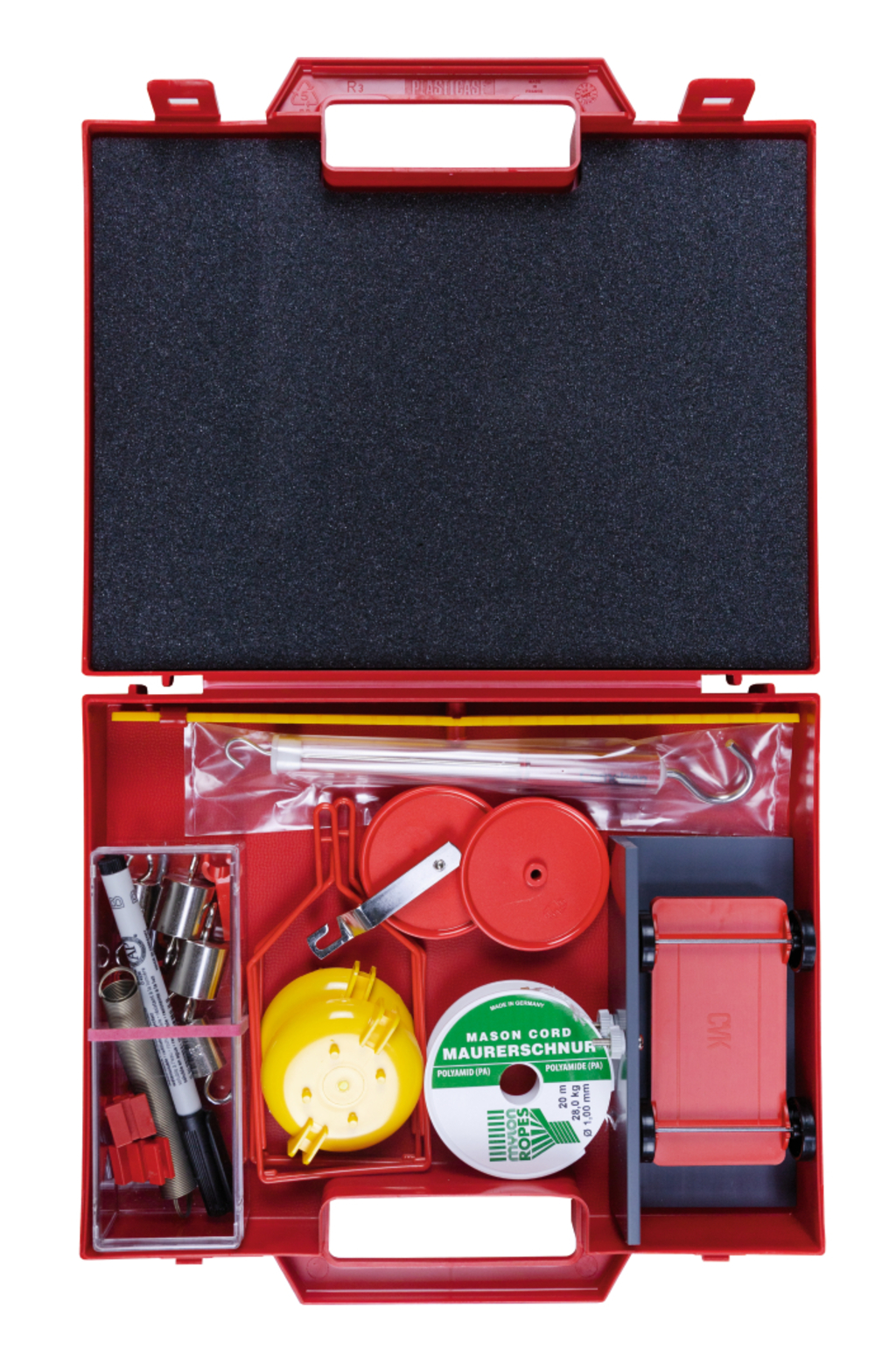
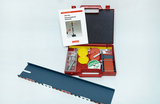
The picture shows a red toolbox containing various materials for experiments. These include items such as strings, measuring instruments, and small components that can be used for practical educational projects in the field of natural sciences.
The picture shows a red and black experimental physics transport box with various components and an instruction manual. The materials included include measuring instruments and accessories for mechanical experiments in the classroom.
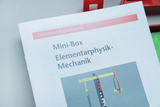
The image shows instructions for a mini box intended for experiments in elementary physics and mechanics. The page shows an experimental setup with various components to illustrate physical concepts.
mehr
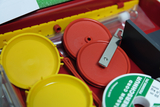
The picture shows an overview of various experimental materials in a red box. You can see yellow and red lids and a metal clip, which can be used for school experiments.
The picture shows a page from a teacher's manual that begins with the topic "effects of force". Below are listed materials that can be used for experiments in the field of physics.
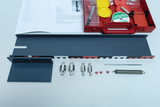
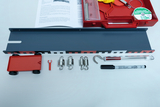
The picture shows various experimental materials, including an elongated metal plate, spring scales, weights and red clips. In addition, instructions and a plastic box with other accessories are visible, which are useful for experiments in the educational field.
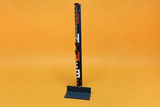
The picture shows an experimental device consisting of a long vertical scale with a spring and several weights. It is used to demonstrate physics concepts such as the spring constant and the force of gravity in educational settings.
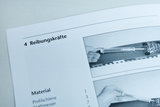
The image shows instructions on the subject of frictional forces. There are illustrations showing various experiments for measuring and analyzing these forces.
The picture shows an arrangement of experimental materials, including a gray rail, a red vehicle, various hooks and weights, and a textbook with instructions. These materials are designed for educational experiments to develop physical
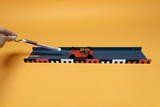
The picture shows a scientific experiment setup consisting of a small platform on a rail equipped with two motors. In the hand someone is holding a measuring device that is probably used for the experiment process.

item number 16100

Share product on:        

Introduction to the effect of force and how it is measured.


Explanation of how the mass of a body is measured.


Finding the center of gravity of a body.


Investigate forces and masses on the roller.


Explanation of how the force is measured.


Investigate friction during sliding and rolling.


Investigating the stability depending on the point of application of the force.


Comparison of masses is observed.


Explanation of the lever laws on the two-sided lever.


Explanation of the lever laws on the one-sided lever.


Possibility of a scale with unequal arms is explained.


Compare ratios of masses related to equilibrium.


Force measurement on the loose roller.


Determination of the balance of power in the block and tackle.


Investigate the forces on the inclined plane.


  • 1 ×
  • 1 × Spring scales, capacity approx. 75 g
  • 1 × Carriage
  • 1 × Pulley, unmounted, 58 mm dia.
  • 4 × Tubular clips, 5 mm
  • 2 × Scale plan, yellow, with bows
  • 1 × Plastic box 140/50/35 mm
  • 1 × Angled stand base
  • 1 ×
  • 1 × Cord, demonstration, 1 mm dia.
  • 1 × Pulley with hook
  • 1 × Metal axle, 125 mm
  • 1 × Spring 100 mm / 12 N
  • 1 ×
  • 1 × Foam cutting, green, 145 x 80 x 20 mm
  • 2 × Clamp block
  • 1 × Lidfoam R3, grey 260x200x10 mm
  • 1 × Friction pad (foam) 95/45/10 mm
  • 1 × Lever with three bores and clamp socket
  • 2 ×
  • 2 ×
  • 1 ×