Vinus explores the world - topic water, set of 1
Investigating the Properties and Phenomena of Water through Exploration
Grade level: Grades 1–2 and above
Number of students: 2–3 students
Materials: for 1 working group or demonstration
Use: Inquiry-based student experiments on the properties of water, surface tension, buoyancy, floating and sinking, water movement, capillary action, solubility and states of matter
With Vinus explores the world - topic water, set of 1, primary school students investigate different properties and phenomena of water. The experiment materials are designed for 2–3 students and combine scientific exploration with stories about the curious alien Vinus and his friends Ben, Lili and Jojo.
The experiments are embedded in five connected episodes. Students investigate optical phenomena in water, surface tension, floating and sinking, and buoyancy. They build their own boats, create waves and water vortices, and investigate how webbed feet work.
Further investigations demonstrate how water is transported through capillary action and which substances dissolve in water. States of matter and other water-related phenomena are also explored within the stories.
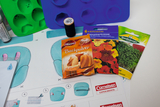
The included Concept Stories introduce the questions addressed in each episode and support independent exploration. Additional materials such as ice cube trays, cress seeds, colouring agents, salt and sugar enable students to carry out the planned investigations.
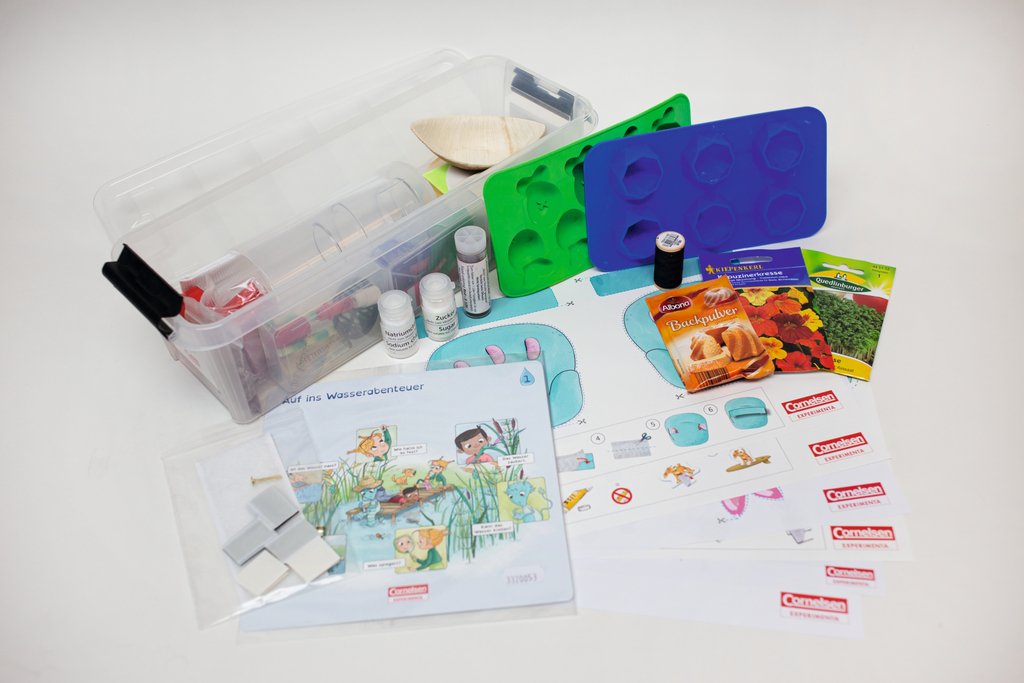
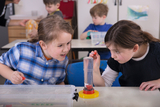
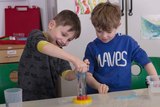


Children explore the properties of water using their senses. The aim is to feel water, to examine the taste and the color of water. The conditions for a reflective surface can be experienced. Sounds in and under water, of and with water are explored.
The first experiences with optical illusions in the transition from air to water are made. The "bend in the drinking straw" as well as the reversal of direction at "Jojo" behind the pipe fascinate the children.
Students explore how water drops can be transported in different ways. The functionality of the pipette is tested. The children learn that water in a cylindrical cup as well as a spherical drop has a magnifying effect.
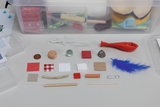
The physical characteristics of water (adhesive force, adhesion and cohesion) are explored with the help of the size-adjustable Vinus hands or paint paddles that stick together. Various small parts and everyday objects can be examined and compared with one another in terms of their properties with regard to adhesion to the Vinus hands.
The students investigate the surface tension of water as a "water mountain" on a coin or in a small, already overfilled cup. To do this, they practice fine motor skills with a pipette or drinking straw.
The phenomenon of buoyancy is explored and rules can be found for when materials and bodies float or sink. The properties of everyday materials provide clues that can be used to explain buoyancy and displacement.
Students apply creative solutions to make non-buoyant materials float using buoyant materials.
Through an enlarged support, the children get to know the principles of displacement and buoyancy of water.
The controlled descent and ascent in water is explored by the students. The functioning of the swim bladder in fish or the descent of submarines can be easily understood.
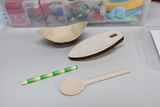
Children explore the principles of the shape and material composition of boats and develop their own buoyant constructions.
Using a variety of techniques and materials, the children imaginatively try to move the boat and surfboard in the tub. The creation of waves and the observation of this spread of movement of the water are studied with fascination.
Students explore the phenomenon of whirlpool formation as water spills out. With the help of the cooking spoon and vigorous stirring movements, funnel-shaped vortices ("water trunks") can be created.
Not only the existing watercraft (palm leaf boat and surfboard), but also self-constructed boats made of plasticine are carefully explored by the children in terms of their buoyancy.
The phenomenon of water resistance is studied and the relationship between area and resistance can be experienced and deduced.
Children learn in a unique way how webbed feet work in nature and can experience the principles on themselves with the help of the webbed feet in complete fascination.
Students* learn how plants drink and also that water can be moved against gravity (using the capillary suction effect). In the context of paper chromatography, the spread of color carried by water is shown.
Almost enchanted, the children experience the independent "blooming" of the folded water lily flower on the water.
The lotus effect is studied in detail by the children. The experiment materials are used as well as the nasturtium that they have grown themselves, which exhibits this effect wonderfully on its leaves. The leaves in the immediate vicinity can also be investigated and analyzed in a planned manner.
The students learn that substances do not simply disappear, but that sugar and salt, for example, can dissolve (in water). An extension of the experiment can be the separation of the substances that were initially combined.
The phenomena of germination and growth in plants are explored here. The children experience these processes and, in addition to the scientific laws, also learn about responsibility for nature and the handling and care of plant life.
Students experience the process of "drinking" in plants very vividly by leaving white flowering plants or vegetables such as celery in colored water for some time and observing the effects.
First experimental experiences with the different states of water are made. The children learn how the transitions of the states of matter solid to liquid (melting ice) and gaseous to liquid (condensation) can occur. Liquid to gaseous is examined in the homework area.
Students explore the changes in water when it freezes. For this purpose, self-collected natural objects are frozen in water and thawed again. In addition, a different salt content of the solution can become a research assignment.
The prepared ice (diamond and fish shapes) is examined by the children in terms of its properties: how do I get ice to melt? What happens to ice in water? What effects result (temperature differences, etc.)?
The phenomenon of density anomaly of water, which is essential for survival in nature, is sufficiently explored by the children.
The children investigate the question of why salt is spread on the roads in winter. With the help of a skill-building variant, they learn how ice can be melted by salt and even how small chunks can be fished with a string.
First experiences with weather phenomena and their systematic investigation are undertaken. Rain can be collected and evaporation can be studied in the classroom or at different temperatures and solar radiation (respectively near the heater in winter).
- 1 × Granulated sugar
- 1 × Dye (food colouring), red
- 1 ×
- 1 × BluTack
- 1 × Spool of thread
- 1 × Ice cube diamond
- 1 × Ice cube fish
- Baking powder (5 pack.)
- 1 ×
- 1 ×
- 1 ×
- 1 ×